
 MCP server


In October, I launched a product. This week, the 100th person paid for it.
That might sound small. In a world of “10K MRR in 30 days” threads and Series A announcements, 100 customers in 5 months is not a headline. But I want to tell you what those 100 people actually represent, because I think the story is more interesting than the number.
I build Respira, a tool that lets AI assistants edit WordPress websites safely. Think of it this way: instead of an AI generating code and hoping it doesn't break your site, Respira gives the AI structured access to your page builder's native format. It can change a headline, rearrange a layout, update a product listing, and scan for accessibility issues, all without ever touching your live site until you approve the changes.
I build it alone, with Claude Code as my development partner, from Brașov, Romania. No team. No investors. No advisor board. Just me, late nights after the kids fall asleep, and an AI that writes better PHP than I do.
what 100 actually means
Some of those 100 people bought a €19/year starter license. Some bought €199 agency plans. A few stacked multiple licenses. One person asked about a 500-site plan before I even had a tier for it.
They did this when the product had rough edges. When there was a bug that wrote changes to the wrong site. When certain page layouts crashed the system. When the interface for approving changes was confusing.
3 asked for refunds. I gave every one, no questions, within hours. And then I published the bugs they found, named the fixes after their feedback, and shipped better versions because of what they told me.
One refund became my best release. A customer named Frank emailed saying the product broke his Elementor site. He was right - three specific bugs I hadn't caught. I fixed all three, cut the amount of data the AI needed per edit by 70%, and built a smarter system for reusing work instead of starting fresh every time. Three features from one honest email.
That's not a failure story. That's how software should grow.

If you were one of those 100: your first name is now on a Thank You page inside the product. Small gesture, quietly listed. Your price is locked forever. Nothing changes for you.
the month everything leveled up
March was the biggest month in the product's life. Not in revenue, in depth.
I shipped 66 new capabilities in one release. I built a dedicated intelligence layer for one specific page builder that required understanding its entire data structure, its CSS framework integration, and its concurrent editing patterns (Bricks). I launched a marketplace of 26 AI workflows that auto-sync from GitHub daily and are free for every user.
The numbers: 172 tools total, up from 106 at the start of the month. Support for 11 different WordPress page builders. Almost a million lines of code pushed through the system by real users on 448 websites.
But the thing I'm most proud of isn't a feature. It's the safety architecture.
Every edit the AI makes happens on a duplicate of your page. Never on the live version (unless you want that - there is a setting you can turn on). You review the changes, compare before and after, and approve or discard. If someone edits the page in WordPress while the AI is working, the system detects the conflict and fails cleanly instead of silently overwriting their work.
In a world where AI tools are racing to be faster and more autonomous, I chose to make mine slower and more careful. That turned out to be the right bet. The people who trust AI with their production websites = the ones running businesses on WordPress, serving real customers = they don't want speed. They want safety.
why the pricing is weird
New pricing went live this week. Three subscription tiers. And a Founder plan.
The prices are €9, not €8.99. €71, not €69.
This is deliberate. I've been calling it “anti-marketing pricing.” Round numbers that don't pretend to be cheaper than they are. No countdown timers, no “only 3 seats left” urgency, no annual-only tricks to inflate LTV metrics.
Every feature is available on every plan. There are no locked capabilities. If you're on the smallest plan at €9/month, you get the same 172 tools as someone paying €309/year. The tiers differ by how many websites you manage. Nothing else.
I thought about this for a long time. There's a concept from Adlerian psychology called Gemeinschaftsgefühl. It translates roughly to “community feeling through contribution.” The idea is that belonging comes from what you give, not what you consume.
That became the design principle for everything.
The Skills Marketplace - 26 AI workflows for audits, migrations, accessibility fixes, SEO optimization - is free for every user. Open-source on GitHub. Community-built. You use a skill, you improve it, you share your own. The value compounds because everyone adds to it.
The Founder plan isn't a premium tier with exclusive features. It's five seats worldwide, €5,001 each, with quarterly calls where those five people shape what gets built next. It's not about access. It's about influence and contribution.
I don't know if this pricing philosophy will work at scale. Most SaaS advice says to gate features, create urgency, and optimize for annual prepayment. I'm doing none of that. But the 100 people who already paid seem to appreciate it. And I'd rather build something that 1,000 people genuinely value than something that 10,000 people tolerate because they're locked in.
building alone, in public
People ask me how I build this alone. The honest answer: I don't, really.
Claude Code writes the PHP and TypeScript. I make the architectural decisions, design the user experience, write the copy, talk to customers, and decide what to build next. The AI is my engineering team. I'm the product person, the designer, and the founder.
Understanding what people need, how they think about value, where the friction is. The AI handles the part I was never great at (writing thousands of lines of production code). I handle the part AI is still bad at (knowing what to build and why).
I share everything publicly. The telemetry is live on the homepage - real numbers, not cherry-picked metrics. The release notes explain not just what shipped but why and what was broken before. When users find bugs, I publish the bugs and the fixes together.
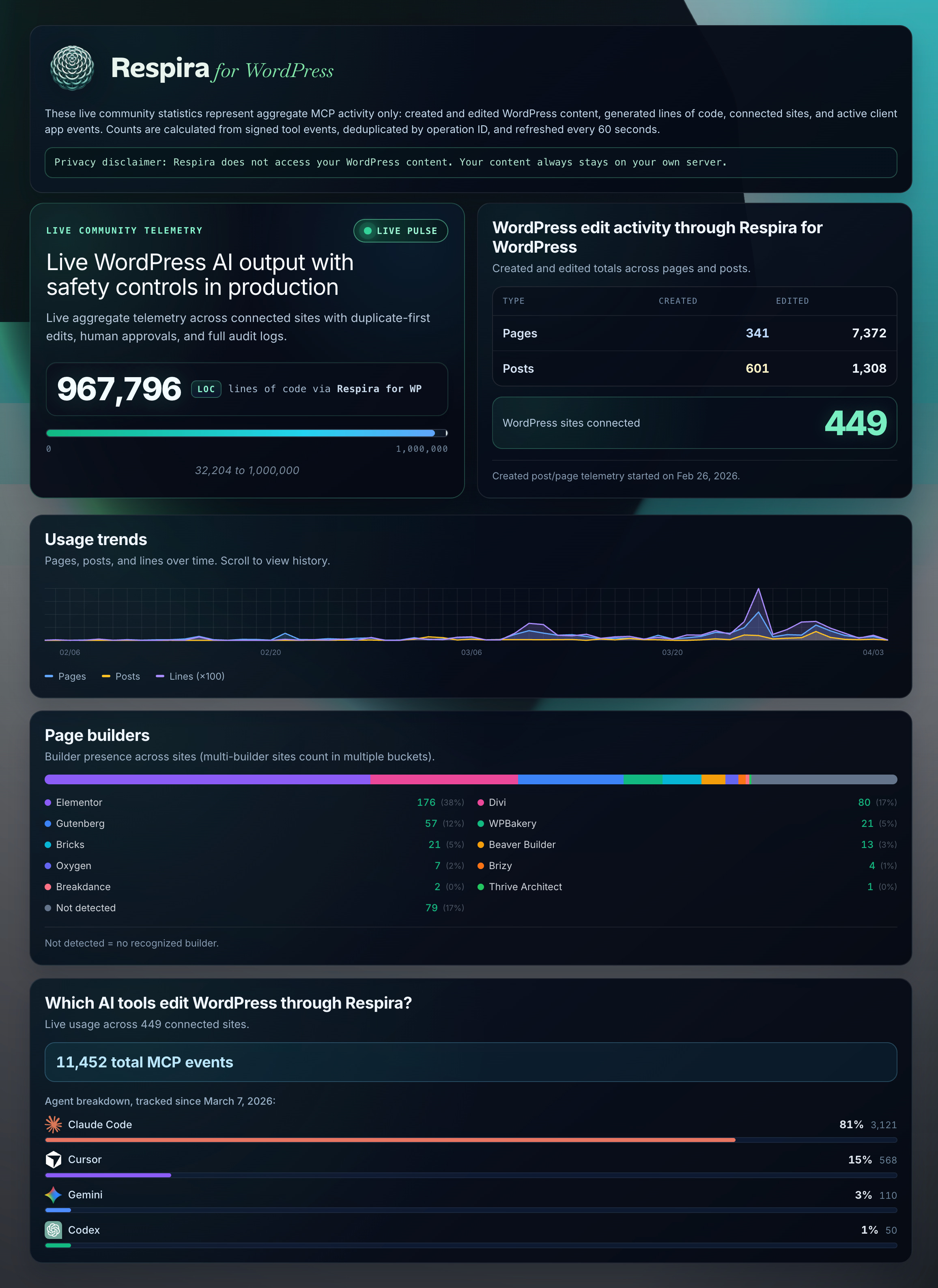
This transparency costs something. A competitor can read my entire playbook. A skeptic can see my rough edges. But it earns something too: the 100 people who paid did so with full information. They knew exactly what they were buying, including the parts that weren't finished yet.
I think that's worth more than any growth hack.
what's next
A free version of the plugin for WordPress.org. A 12th page builder. A dashboard redesign that I've been working on this week (the current one looks like it was built at 2am, because it was) - oh, this was was done before finishing the article :).
And the Slack community just opened. Support each other. Share what you're building. Give more than you take, so there's always something to take.
Mihai
Brașov, Romania
4 April 2026

Join the conversation
0 comments · Respira accountNo comments yet. Be the first to weigh in.