
 MCP server


ChatGPT, Claude, Copilot and Google AI Mode already recommend products to millions of shoppers. Shopify flipped one switch in March and made every store on its platform readable to them. A WooCommerce store, in July 2026, is still invisible to AI assistants unless somebody does the work by hand.
Respira ARC does the work. It is a free plugin, it runs entirely on your own server, and I have just submitted it to the WordPress.org plugin directory. While their review queue does its thing, you can download it from respira.press/arc and install it via Plugins, Add New, Upload.
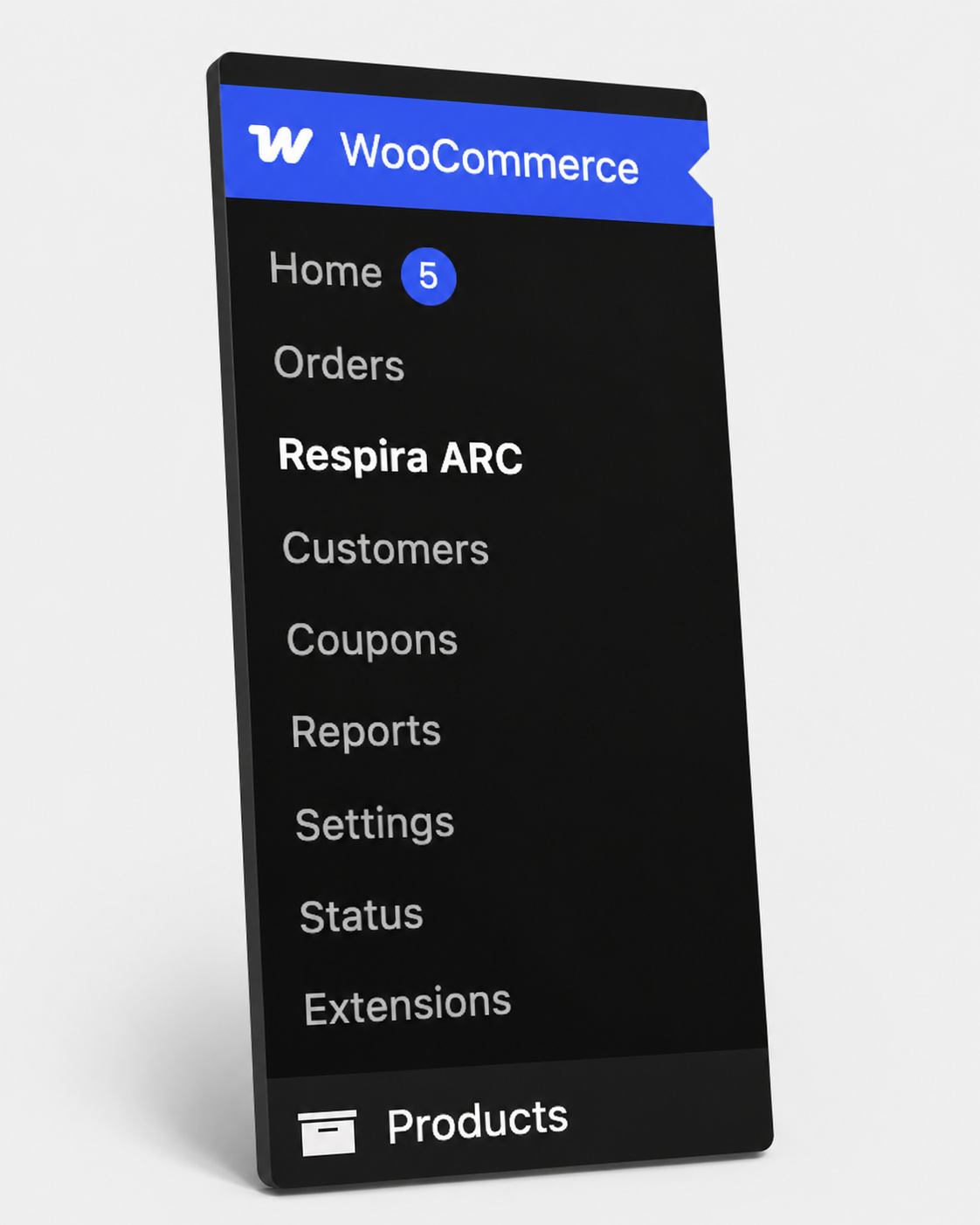
ARC stands for Agent-Ready Commerce. It does four things, properly.
1. Product feeds in six formats, always fresh
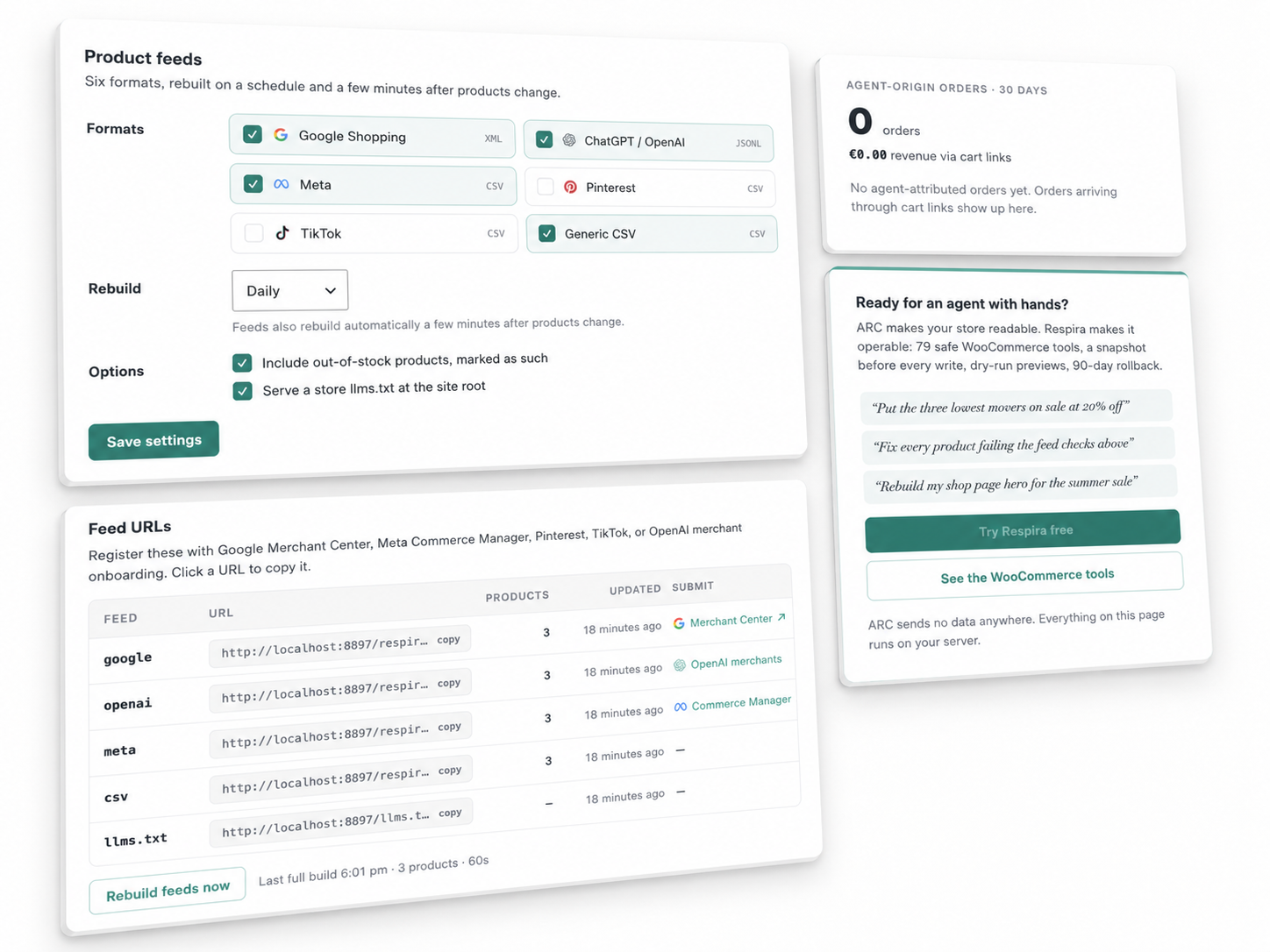
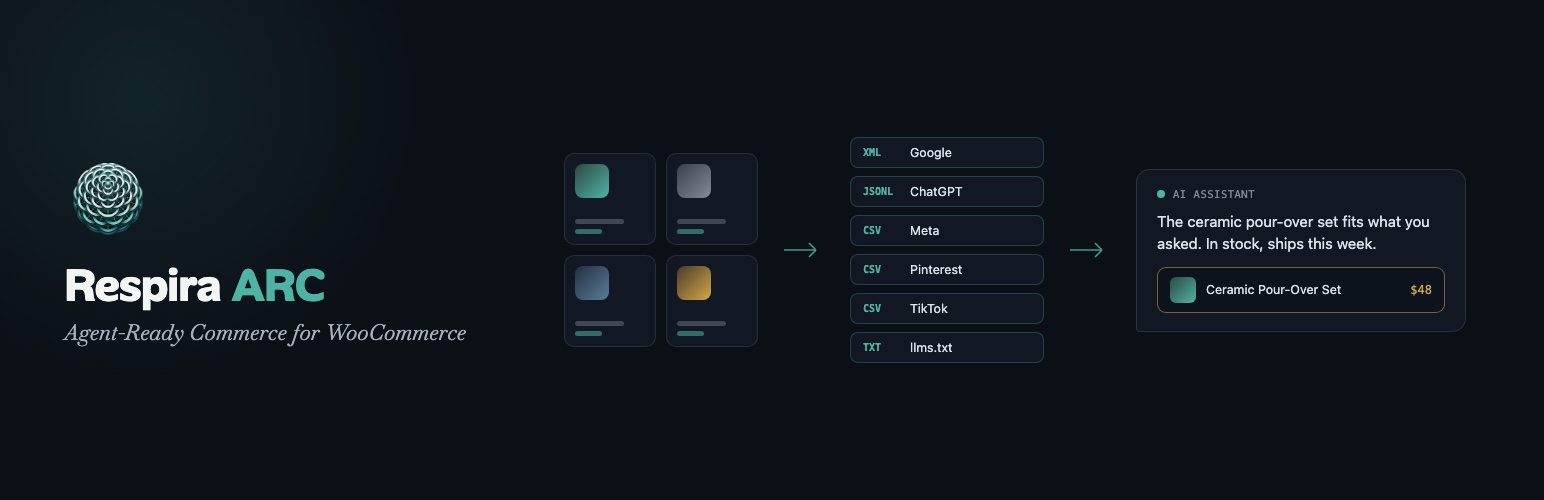
One catalog walk builds every format the shopping platforms actually ingest: Google Shopping XML for Merchant Center (Bing accepts the same file), OpenAI JSONL per the ChatGPT product feed spec, Meta CSV for Facebook and Instagram, Pinterest CSV, TikTok CSV, and a generic CSV for everything else.
Feeds rebuild on your schedule and again a few minutes after products change, in background batches, so a shopper never waits on feed generation. Variations export as proper variant rows grouped by item_group_id with per-variation prices and images. Sale prices carry their date windows. Identifiers follow each platform's rules, including Google's identifier_exists logic. The files are served as static files from a tokened URL on your own domain: your feed lives on your server, not on somebody's CDN.
2. A store llms.txt
A machine-readable summary served at yoursite.com/llms.txt: what you sell, your policy pages, your top categories, and where the feeds live. It is the file AI assistants look for first when they try to understand a site, and almost no store has one.
3. An AI-readiness score
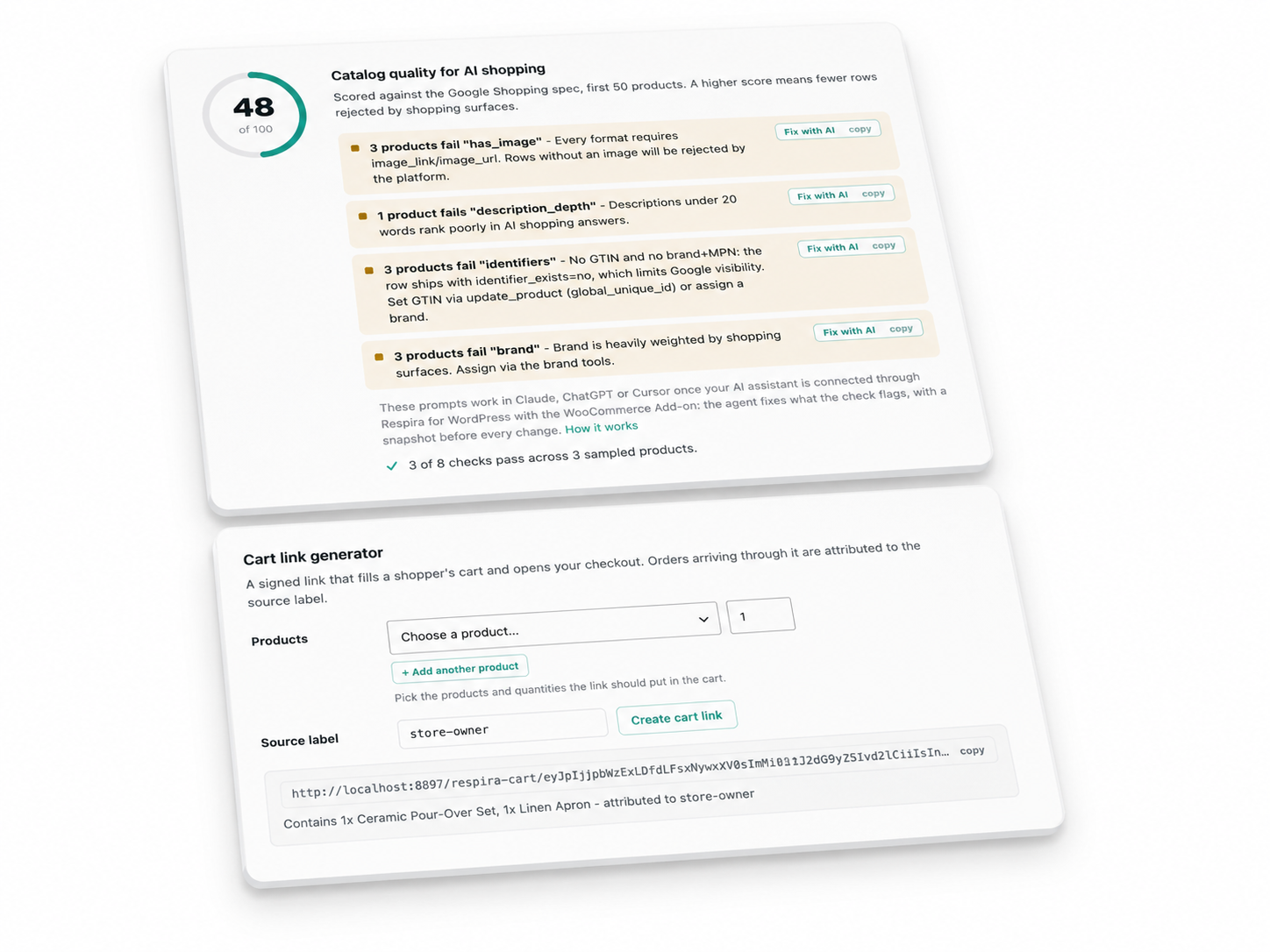
Your catalog, checked against the Google Shopping spec, with the exact failing products and what each one is missing: images, real descriptions, brands, GTINs, category mapping. A higher score means fewer rows rejected by shopping surfaces. The community consensus in every thread I have read on this is right: catalog quality is the foundation, the protocol layer is just plumbing that exposes what is already there.
4. Cart links with attribution
Signed links that fill a shopper's cart server-side and land on your own checkout. Orders arriving through them are attributed to their source through WooCommerce's native order attribution plus an order-meta safety net, so you can finally see the orders and revenue AI assistants send you. Checkout, payments and customer data never leave your store.
Free means free
Every format, every feature, any catalog size. No accounts, no API keys, no product caps, no trial, no telemetry, no external connections. The paid products on this shelf cap you at 100 products or host your feed on their infrastructure. ARC does neither, because the feeds are not where the value of an agent-operated store lives.
Where the Respira WooCommerce Add-on comes in
ARC tells you what is wrong with your catalog. The Respira WooCommerce Add-on gives your AI assistant hands to fix it: say "fix every product failing the feed checks" and the agent writes the descriptions, assigns the brands, sets the GTINs and the alt text itself. That is 79 WooCommerce tools with a snapshot before every write, dry-run previews on anything destructive, and 90-day rollback. The add-on includes everything ARC does, so you never need both installed. If both are present, ARC steps aside automatically and your settings carry over.
I wrote up the add-on's new agent-ready commerce capabilities separately: what shipped in v3.1.
Why give this away
Because discovery should not be the moat. Any store should be findable by the assistants its customers already use, the same way any site can have a sitemap. The moat, if you want to call it that, is what happens after discovery: an agent that can safely operate the store. That is Respira, and ARC is how a store owner meets it.


Join the conversation
0 comments · Respira accountNo comments yet. Be the first to weigh in.