
 MCP server


Every AI session starts with an assistant that has never seen your site before. It asks about your builder again. It reaches for raw HTML again. It edits the one page you told it, three chats ago, to never touch. As of today, Resonance remembers for it. Resonance is a small, persistent memory that lives inside WordPress itself, plus something no memory feature i know of has: rules the plugin enforces, no matter what the model reasoned.
Two kinds of memory
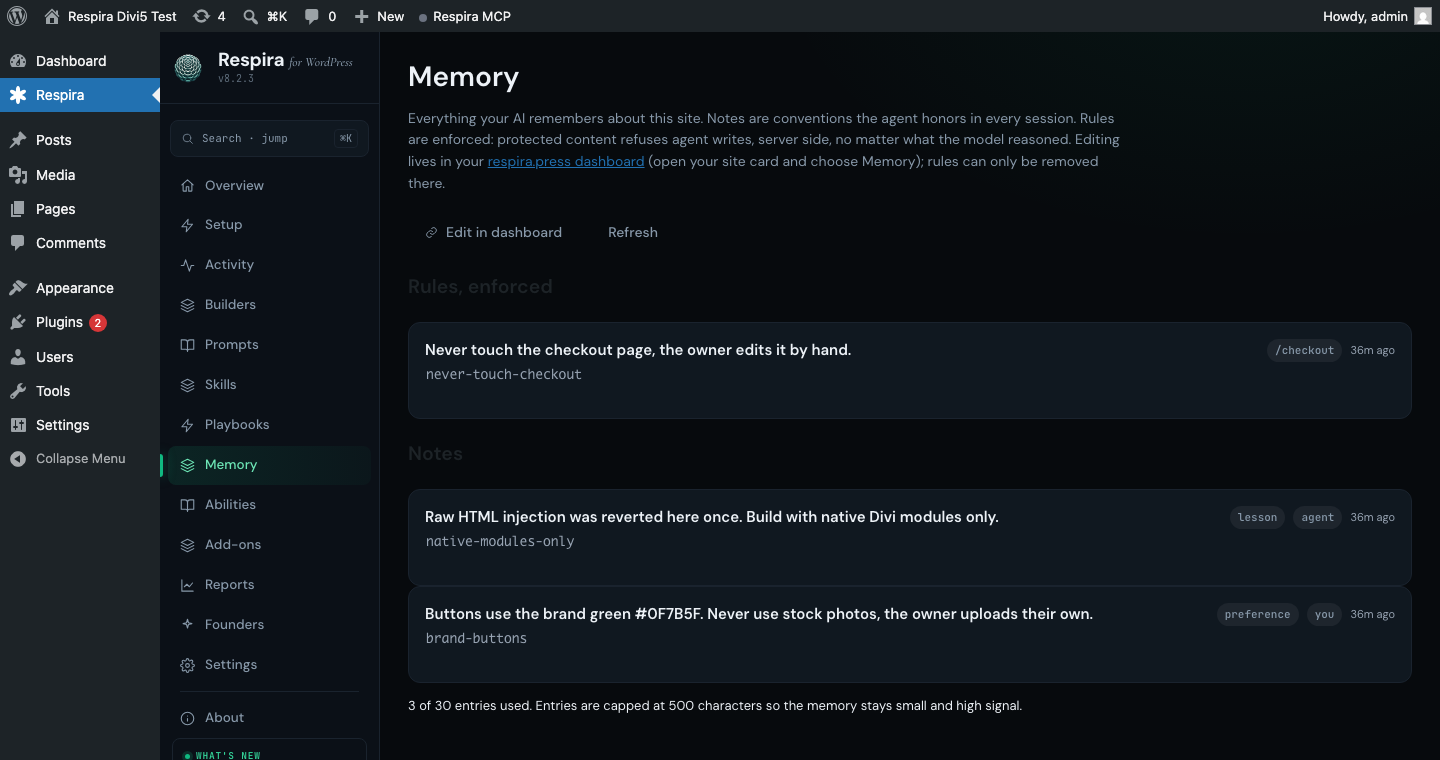
Notes are what your site knows: facts it observed, preferences you stated, lessons learned from mistakes. "Buttons use our green." "Native modules, never raw HTML." "Raw HTML injection was reverted here once." Notes ride into the site context every agent receives at the start of every session, from any client you connect. Say it once, and every future session starts already knowing it.
Rules are different. A rule is not a suggestion the model may or may not honor. Mark the checkout protected and the plugin refuses AI writes to it, server side, at the write path. Direct edits, element operations, deletes, even agent-mediated publishing of a staged copy: all refused, with a receipt naming the rule. Your own wp-admin is never restricted. Rules bind the AI, not you.
There is a deliberate asymmetry in who controls them. Your assistant can add protection during a conversation: "never touch the checkout, make that a rule" works exactly as you would hope. But no conversation can remove or weaken a rule. Removal is a human act, in your dashboard, behind a confirmation. A prompt injection can raise your defenses. It can never lower them.
The conversation way
There is nothing to configure. Update to plugin 8.3 and MCP server 8.2, and memory arrives with the site context your agent already reads. Then just talk:
- "From now on, buttons use #0F7B5F. And never use stock photos, i upload my own."
- "Never touch the checkout page. Make that a rule."
- "What do you remember about this site?"
Under the hood these are three new tools: respira_remember, respira_forget, and respira_list_memory. The agent is instructed to ask before saving anything you did not state yourself, and to offer to remember when you state a durable preference or correct a mistake worth not repeating. The store is capped on purpose: 30 entries of 500 characters per site, so what your agent reads stays small and high signal.
The dashboard way
Some people want to see the memory file. In your respira.press dashboard, under Memory, every site's memory is visible and editable: notes and rules, who wrote each entry, when it last changed. It is the one place rules can be removed. And because memory lives per site, the dashboard can do what conversations cannot: carry your conventions across your portfolio, copying a note or a rule to your other connected sites.
The plugin has its own window too: Respira, then Memory in wp-admin shows everything your AI knows about that site, read-only, with a link to edit in the dashboard.
WordPress core is heading the same way, and Resonance already speaks it
The WordPress AI team is building Knowledge: a native wp_knowledge post type for site guidelines, memories, and notes, with a Guidelines feature that captures voice, tone, and editorial standards per scope. It was proposed for core in WordPress 7.1 and Matt Mullenweg postponed it, saying AI features need real-world adoption before landing in core. Today it lives as a Gutenberg experiment, a candidate for 7.2 and beyond.
i think the direction is right, and i did not wait. On sites running the Knowledge experiment, Resonance reads the published guideline scopes and delivers them in the same memory block your agents receive, alongside your notes and rules. Core provides the storage. Resonance is the layer that carries it to every connected AI client and enforces what must not break.
Which is, i think, the honest way to read this moment. Core ships primitives and asks for real-world adoption. The adoption exists: through Respira alone, agents have written over 10 million lines of code across 2,100+ self-hosted production sites, a quarter million signed tool calls, most of it Claude Code, all of it visible live at respira.press/live. The WordPress AI conversation is no longer a proposal thread. It has a production ecosystem, running on real sites, proving which primitives matter. Site memory is one of them, and now it ships.
Availability
Resonance is included on Builder and Studio plans at no extra cost, with plugin 8.3 and MCP server 8.2. Maker covers one site; Resonance exists for the moment your sites outnumber your patience for re-explaining them. The full story, with prompt examples and the enforcement receipts, is at respira.press/resonance.

Join the conversation
0 comments · Respira accountNo comments yet. Be the first to weigh in.