
 MCP server


Yesterday WordPress.com shipped Guidelines: a persistent brand memory that the WordPress Agent reads from, so you stop re-explaining your voice, your colours and your rules on every task. It is a good feature and the premise is exactly right. The thing worth saying out loud is that this is now the third place the same idea has landed in three months, and the interesting question is no longer who has a memory. It is what a memory is allowed to do.
Three places, one idea
WordPress.com has Guidelines, live as of yesterday. Settings, then Guidelines. You describe your brand across a few sections, and the WordPress Agent draws on it in the editor, over Telegram, and over email. There is a "Suggest guidelines" button that reads your existing posts and pages and drafts every section for you, which you then accept, edit or dismiss. It needs the Agent enabled on a paid plan.
WordPress core is building Knowledge: a native wp_knowledge post type for guidelines, memories and notes. It was proposed for 7.1 and Matt Mullenweg postponed it, on the reasoning that AI features need real-world adoption before they land in core. It lives as a Gutenberg experiment today, a candidate for 7.2 and beyond.
Self-hosted sites have Resonance, shipped 3 August in plugin 8.3. Same premise: a small persistent memory that lives inside WordPress itself, read by every AI client you connect. On sites running the Knowledge experiment it reads the published guideline scopes too, so core supplies the storage and Resonance carries it out to whatever you are actually talking to.
Three teams arriving at the same conclusion within a quarter is not a coincidence. It is what happens when enough people notice the same tax. Every session starts with an assistant that has never seen your site, so you spend the first five minutes describing it, and you still get something generic.
The part that is not the same
Every one of these is a memory the model reads. Reading is the easy half. A guideline that says "always call them sessions, never appointments" fails softly when it is missed: you get the wrong noun and you fix it.
Some instructions do not fail softly. "Never touch the checkout page" is not a stylistic preference. It is a boundary, and the cost of the model being distracted on the day is not a wrong noun. This is the distinction Resonance draws, and it is the reason it has two kinds of entry rather than one.
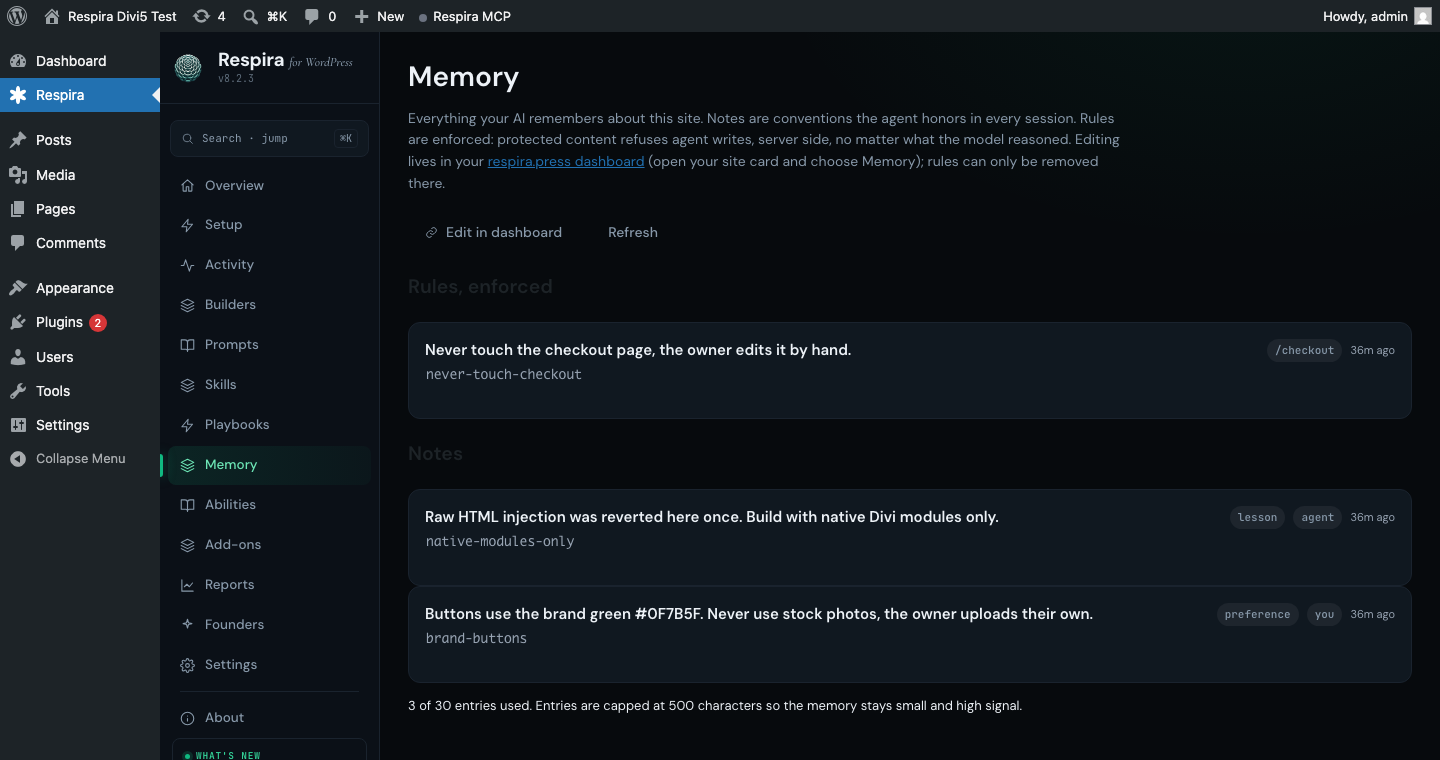
Notes are advisory, and they behave like Guidelines: facts the site observed, preferences you stated, lessons from something that went wrong once. They ride into the site context at the start of every session. Say it once, and every session after starts already knowing.
Rules are enforced. Mark the checkout protected and the plugin refuses AI writes to it, at the write path, server side, with a receipt naming the rule that refused. Not "the model decided not to". Direct edits, element operations, deletes, and agent-mediated publishing of a staged copy are all refused. Your own wp-admin is untouched: rules restrict the assistant, never the owner.
There is a deliberate asymmetry in who can move them. Your assistant can add protection mid-conversation, because "never touch the checkout, make that a rule" should work exactly as you would hope. No conversation can remove or weaken one. Removal is a human act, in the dashboard, behind a confirmation. A prompt injection can raise your defences. It can never lower them.
That is the whole argument, and it is smaller than it sounds: a memory the model reads is only as good as the model's attention that day. On most pages that is fine. On the pages that carry money it is not, and the failure mode is one nobody wants to discover from a customer.
Whose memory is it
The second difference is quieter and it matters more over time. Guidelines belongs to the WordPress Agent. It makes that one assistant better, which is a real thing to want if that assistant is the one you use.
Self-hosted people do not work that way. They change assistants more often than they change sites. Resonance stores memory in the site's own database, and every connected client reads it: Claude, ChatGPT, Cursor, Codex, whatever you switch to next quarter. The memory travels with the site, not with the chat. If you have ever rewritten your brand rules into a second tool's settings screen, you already know why that is the axis worth designing on.
It also means the memory is a thing you own and can read. Every entry is visible, editable and deletable per site in the dashboard, and read-only in wp-admin under Respira, then Memory. It is capped on purpose at 30 entries of 500 characters, so what your agent loads stays small, high signal, and cheap.
What WordPress.com does better
The "Suggest guidelines" button. The Agent reads your existing posts and pages and drafts every section, and you accept or dismiss. That is a genuinely good idea, because the honest failure mode of any memory feature is the empty box: people set it up, look at a blank field, and never come back.
Resonance does not have that. It fills up through conversation instead, which works well once you are in a session and not at all before your first one. I would rather say that plainly than pretend the two approaches are equivalent. It is on my list.
Why this direction is now settled
Core asked for real-world adoption before AI primitives land in WordPress. It exists. Through Respira alone, agents have written 12,056,861 lines across 2,464 bridged self-hosted sites and 320,825 recorded events, live and counting at respira.press/live. Site memory is one of the primitives that proved itself in that traffic, which is why it shipped here in August rather than waiting for a core release cycle.
So this is not a race, and I am not interested in framing it as one. If your site is on WordPress.com, turn Guidelines on. If you self-host, the equivalent exists and it enforces as well as remembers. Either way the re-explaining tax is ending, and that is worth more than which logo got there first.
Resonance is included on Builder and Studio plans at no extra cost, with plugin 8.3 and MCP server 8.2. The full picture is at respira.press/resonance, and the launch write-up, including how it reads the core Knowledge experiment, is at the Resonance release post.

Join the conversation
0 comments · Respira accountNo comments yet. Be the first to weigh in.