
Release notes · v4.2 → v9.3.14

Every release,
every story.

A single timeline. Every version Respira has shipped, with the stories behind the ones that mattered. Click into any release tagged story for the full write-up.

Connect your WordPress site
Looking for the plugin? The download and your license key are in your dashboard, one free sign-up away. No card.
810 Releases shipped
15 With a landing page
9.3.14 Latest stable
368 days Since v1.0
Product
Filtered Oxygen · 8 releases See Oxygen MCP → Clear
November 1, 2026
WordPress plugin v9.3.1 Patch November 1, 2026 Say where a site template applies, without opening wp-admin Security Every ability run meets the site's rules, on every route (and 2 more)
  • Captain Picard. Part of the October release, in memoriam Sir Patrick Stewart, 1940 to 2026. The pledge in 9.3.0 stands. The month's work is told at https://www.respira.press/make-it-so.

  • Say where a site template applies, without opening wp-admin. Two new tools, get_template_conditions and set_template_conditions, read and set where a header, footer, single, archive or popup template shows: the whole site, the front page, post types, archives, terms, single pages, search, 404 and excludes, as far as each builder has them. Conditions come back in the same plain words on every builder, with the builder's own value beside them, and the builder itself decides which template wins when two match. A write changes the live site at once, so it needs the person's yes first (confirm_live_edit). It takes a snapshot, reads the result back and requests real pages to confirm, and restore_snapshot undoes it in one call. Anything a builder cannot express is refused by name and nothing is written; a native rule with no shared word stays as it is. Checked with real page requests on Bricks 2.3.4 and 2.4.3, Divi 4.27.8 and Divi 5.13, Breakdance 2.8.3 (free), Oxygen 6.1.1, Oxygen classic 4.9.6 and 4.9.7, Beaver Themer 1.5.3 with Beaver Builder 2.11.1, Avada 7.16.2, YOOtheme Pro 5.0.50, free Brizy 2.8.16, and block theme templates on Twenty Twenty-Five.

  • On Divi, a template can be switched off, and its header, body and footer set. set_template_conditions takes template_settings for that. Two templates can share one layout when you ask for it with share_layout, and the answer names every template that holds it, because an edit then reaches all of them. A list that leaves out an existing exclusion is refused, so pages you kept out of a template stay out unless you agree.

  • A safe homepage switch. switch_front_page makes a published page the homepage and get_front_page shows which page it is now. On a Yoast SEO site the switch also fixes what Yoast stored for both pages, so the new homepage no longer prints the old address as its canonical, sets noindex on the old homepage and clears a stale one on the new. It clears page caches, then requests both pages and reads what they print. A step that fails is put back at once; a check that fails answers with the undo. Checked on Yoast SEO 28.7.

  • More of Yoast SEO's settings. get_yoast_settings and update_yoast_settings cover crawl cleanup, llms.txt, site representation, social profiles, the default social image, archives, an author's noindex, and cornerstone and schema type on many posts at once. With regenerate_llms_txt it rewrites llms.txt at once instead of waiting for Yoast's weekly run.

  • See what Code Snippets runs, read only. list_code_snippets gives each snippet's name, scope, type, state and whether it has an error, without the code. Respira does not write snippets: saving one runs its PHP on the site.

  • Sort Divi posts before a template change. classify_divi_posts tells real designs from plain text in Divi 4 and Divi 5 posts, with the reasons, so a designed post is not moved onto a template by mistake. It changes nothing.

  • The real memory limit. get_site_context and the diagnostics now show the memory PHP really has beside WP_MEMORY_LIMIT, and say plainly when the host holds it lower.

  • Every ability run meets the site's rules, on every route. Switched-off tools, approvals, Observe and Publish only now hold when a Respira key runs an ability through WordPress's own abilities route, the MCP Adapter or WebMCP, and Activity names the key that made the call. Before, a full-access key could run switched-off tools there.

  • A Respira key can no longer create or change application passwords. Revoking one still works.

  • Snapshots and meta reads no longer show what they should not. get_snapshot and meta reads no longer return custom PHP from Breakdance and Oxygen template settings, a Bricks template password, or the raw rows of a delete snapshot. Reading a Bricks template through the page, post or conditions tools no longer shows its password to a read-only connection. Restores still use the real bytes.

  • Respira's own update through run_updates really runs. It answered success, then failed quietly on cron with "You do not have permission to update plugins". It now runs with the permission checked when you asked, for Respira only. The first answer says scheduled, not updated, list_updates shows how it ended and why, and Activity records it.

  • Bricks pages can no longer be taken down by one bad setting. Every page write refuses four Bricks settings in a shape that would give every visitor a critical error, says what shape to send, and writes nothing. A value already on the page does not block an edit elsewhere; it comes back as a warning.

  • A write that saved before an error says so. update_element, inject_builder_content, build_page and apply_builder_patch answer write_landed: true when the change was saved before the request failed, and tell the agent not to send it again.

  • Site rules stop bulk runs and the add_ shortcuts too.* An item a rule protects comes back refused and unchanged, and a bulk run no longer writes an item whose snapshot could not be saved.

  • Setting Bricks conditions no longer erases the template's other settings.

  • An Avada condition for posts in a category now matches. It was stored with a type Avada does not read. list_avada_layouts also shows Layouts in Avada's own order.

  • Restoring a whole Oxygen 6 template brings its conditions back, as it does on Breakdance. Divi snapshots now hold Divi's real template keys.

  • run_security_audit no longer reports a false core checksum mismatch after a site's language changes. It still flags a changed file.

  • Over the hourly rate limit, the answer says when calls work again and which batch tools to use, and the plugin's own endpoint no longer asks the client to sign in again.

  • update_option on WPLANG installs the language when it is missing, as Settings, General does.

  • read_debug_log works for an administrator on a site with DISALLOW_FILE_EDIT and reads a host's linked debug.log.

  • update_page and update_post take a page template, reads say when a blank template hides the site header, and a template or custom CSS sent alone can be rolled back.

  • update_theme_builder_template takes custom_css on Divi 4.

  • Page custom CSS keeps its escapes, such as content:"\201C".

  • save_design_direction accepts a page address in sources.

  • The option tools on the plugin's own MCP endpoint take the option name as name, option_name or key.

  • Exhale on Divi 4 writes native modules. Images become Image modules, an image with a title and text becomes a Blurb, and wrappers fold into Divi's rows and columns. Only forms, inline SVG and links around blocks stay in a Code module. On my Divi 4 test page the result has no Code module, where 9.3.0 used 12.

  • Oxygen classic: creating a template with a Respira key fails (404), because Oxygen only registers templates for a signed-in user. Create it in Oxygen, then set its conditions with Respira. This was true before 9.3.1 too.

  • Oxygen classic or Breakdance with a block theme active: a write needs builder "oxygen" or "breakdance" in the request.

  • Breakdance Pro archive rules have not been run on a real Pro licence yet.

  • Template conditions on Elementor Pro, Brizy Pro, GeneratePress Premium, Kadence Pro, Thrive, Blocksy Pro and SeedProd Pro answer plainly that they are not supported.

  • Exhale on Divi 4: on phones, columns with padding can overflow, as in 9.3.0.

  • invoke_ability sent again with no call id can return the earlier answer for up to 10 minutes. Give each run its own _respira_call_id.

  • Server-side PHP inside builder page content, such as a Bricks Code element, is still readable through the read tools.

  • If a PHP fatal error hits while WordPress swaps the plugin files during any update, the site can be left with a .maintenance file and an empty plugin folder. Delete .maintenance from the site root, then install the Respira zip again from wp-admin or by SFTP.

  • Every release is listed at https://www.respira.press/releases.
October 15, 2026
WordPress plugin v9.2.6 Patch October 15, 2026 A site runs at most six Respira calls at once, and says so when it is full
  • A site runs at most six Respira calls at once, and says so when it is full. A managed host cut a site off because AI agent calls held its PHP workers until the host's time limit. The calls themselves were quick; what held the workers was waiting: agents send tool calls in bursts (up to 40 per site in five seconds), and every call in a burst takes a PHP worker while it waits for the others. Now, when six calls are already running, the next one is answered straight away with respira_site_busy, how many calls are running, and how long to wait (retry_after, also sent as a Retry-After header). Nothing runs for a busy call, so sending it again is always safe, writes included, and the Respira MCP server does that by itself. Reads keep one of the six slots for themselves, so a burst of writes can never stop an agent from checking its work. A call that ends in a crash or an exit frees its slot at once; a process the server kills outright frees it once PHP's own time limit has passed. The limit covers AI calls only: the site's pages, wp-admin and other plugins are never counted. To raise or lower it, set the respira_mcp_max_concurrent option (0 turns it off), the RESPIRA_MCP_MAX_CONCURRENT constant in wp-config.php, or the filter of the same name. respira_diagnose_connection shows the limit and how many calls are running.

  • Avada is a supported builder. Pages built with Avada Builder are read and written as Avada's own shortcodes: containers, rows, columns and Avada elements such as titles, text blocks, buttons, images, toggles, tabs, checklists and code blocks. Your AI can find, change, move and remove a single element, add elements with the add_* tools and build whole pages, and loose elements get the container, row and column Avada needs. Everything I do not model, a third-party shortcode, a newer Avada element or a Library global, is kept exactly as it was, byte for byte, and a write that would not read back the same way is refused before anything is saved. After every write I clear that page's compiled Avada CSS so the change shows, and the page's edit link opens it in Avada Live. Tested on a real Avada 7.16.2 site with Avada Builder 3.16.2: pages render, open in Avada Live, and after a save there Respira still reads and writes them byte for byte. Pricing Table, Tabs and Testimonials were rebuilt in Avada 7.16 and are marked experimental; check those in Avada Live after a change.

  • Avada support checked against Avada 7.16.2's own code. Clearing a page's compiled CSS now runs Avada's own per-page reset, the one Avada runs when you save a page, instead of a copy of it that also deleted a cache entry Avada no longer uses. A write that holds an expanded Library global (an element marked with fusion_global, the form Avada's editor works on) is refused before anything is saved: Avada would have copied it over that Library element on every page that uses it. Avada only lists its elements inside wp-admin and its own editor, never on the requests Respira answers, so the element list can now come from a scan of a real Avada Builder (scripts/generate-avada-scan.php writes it) with every element, its child items and every setting with its type, default and allowed values, and the builder info says which source it used. Writing pages on a real Avada site also showed two slips, now fixed: a checklist sent as plain words put each word into its icon setting as well as its text, and a section sent by its generic name was written as an old-style container instead of a flex one. Tabs joins Pricing Table and Testimonials as experimental, since Avada 7.16 rebuilt all three. A Library global is now placed at the level of what it holds: a saved container goes to the top of the page as it is, instead of being wrapped in a new column, where Avada would have nested a container inside a column.

  • Your AI can work with Avada's design system, Layouts and Library. It reads the global colour palette and the five typography sets with the CSS variables elements use (var(--awb-color5), var(--awb-typography1-font-family)), and changes them through Avada's own Global Options, then clears Avada's caches so the whole site shows the change. Because that restyles every page at once, it asks you first, takes a snapshot, and a restore puts the old values back and clears the caches again. Design tokens from a design direction land in the Avada palette as new colours and never overwrite one you already have. Avada Layouts can be listed, read, created and changed: which header, page title bar, content and footer section each Layout uses and which pages it applies to, the Global Layout included, and the sections themselves can be read, built and edited. A new Layout without conditions and a new section start out showing nowhere, so you can look at them in Avada Live first; changing anything already live needs your yes. The Library can be listed and read, with the exact piece to place in a page, and a global item is placed the way Avada places it, so it keeps following edits to the original. Edits to a Layout Section clear Avada's caches for the whole site, as Avada does itself. All of it was checked on a real Avada 7.16.2 site with Avada Builder 3.16.2: a global colour change rendered on the page, a new footer went live site-wide and opened in Avada Live, and a placed Library item followed an edit to the original. Layouts and the Library need Avada Builder active.

  • Elementor 4.3's accordion, background video and list elements can be built and edited. Respira knew 20 of Elementor's v4 element types and refused any write that added or changed one of the 15 that came with 4.3: the accordion (e-accordion and its item, header, title, icon and content slots), the background video (e-background-video with its content, controls, play and pause parts) and the list (e-list, its items, markers and text). All 35 are now modelled from Elementor 4.3.5's own code, with the props each one takes and the children it allows. An accordion item can be sent as { type: "e-accordion-item", title: "Question", children: [...] } and Respira builds the header, title, icon and content slots the way Elementor's editor does; list items can be plain strings. A label that lives in a child paragraph (a tab, an accordion title, the play and pause buttons) is written there when you send content to the slot. The list only exists on a site that has Elementor's e_list feature turned on, which Elementor ships hidden and off, so on other sites a list is refused with that reason instead of being saved and rendering nothing.

  • Inserting into a Divi page no longer rewrites the rest of it. Adding content with inject_builder_content (mode append, a target_path, or the new after_element_id / before_element_id) used to read the whole page into a tree and write the whole tree back. On Divi 5 that pipeline treated every existing block as fresh input: a global module reference at the top of a page (a full width global hero) was wrapped in a new section, row and column and rendered boxed, and a third party form block lost its settings. On a page still stored as Divi 4 shortcodes, a Divi Supreme carousel tag was turned into a section. Now only the new content is serialized and spliced into the stored page at one position; every other byte, including global module references, third party blocks and modules Respira does not know, stays exactly as stored, and the plugin checks that before and after the write. The response reports the inserted node's path and ids, the bytes inserted and the bytes left untouched. A page stored as Divi 4 shortcodes gets shortcodes whatever Divi version the site runs: a Divi 5 shape and the generic shape (section, row, column, then text, heading, button and the other module names) are converted the same way a full-page write converts them, in every insert mode, and a type with no Divi 4 module is refused with nothing written.

  • Chunked builds for Divi 4 and Divi 5. A large page can be built as a sequence of small inserts: the frame first, then rows and modules by path (target_path plus position, into a section or a column). A chunk_id makes a retried call a no-op instead of a duplicate, and a session_id from begin_session keeps one recovery snapshot per page for the whole build. Elementor and Bricks accept target_path inserts through the generic tree graft; get_write_capabilities reports inserts_at_path per builder, and other builders answer respira_target_path_unsupported with the list. The site's own MCP endpoint, the one claude.ai, ChatGPT and other remote connectors use, declares these parameters (target_path, position, after_element_id, before_element_id, chunk_id, session_id) and the insert and chunked build guide on inject_builder_content, word for word as the Respira MCP server does, so an agent on any connector learns it can insert instead of rewriting the page. On a builder without target_path the refusal names the builders that have it (it listed none), and get_builder_info accepts the short slug ("beaver" now finds Beaver Builder instead of answering that the site has no such builder).

  • PageSpeed audits and rendered design checks run in the background. run_pagespeed_audit can take two minutes and check_design with rendered:true about one, holding a PHP worker and an open connection the whole time. On the site's own MCP endpoint they now answer at once with a job_id, run in the background like a backup does, and respira_get_job_status returns the result when it is ready. An agent that needs the answer in the same call can send _respira_async: false. Through the Respira MCP server nothing changes for the agent: the server waits for the job and returns the finished audit. A design check of content, without rendering, is quick and still answers directly.

  • The post editor opens again on PHP 7.4. On sites running PHP 7.4, opening a post or page in wp-admin since 8.8.28 could answer with "There has been a critical error on this website." The image fallback added in 8.8.28 (when a network refuses WebP, convert the picture to a format it allows) handed WordPress a value it can only take as a variable, and PHP 7.4 then refused to load Respira's main file on the editor screens. Front end pages and AI calls were not affected. On PHP 8 the same line failed each time it ran, so that fallback never worked on any PHP version; it does now. A new test checks every by-reference argument in the plugin and compiles every file on PHP 7.4 with WordPress's functions loaded first, the way wp-admin loads them.

  • A background job runs once. On hosts where Respira starts background jobs with a request to the site itself (Apache with mod_php, some LiteSpeed setups, PHP's built-in server), a job that finished in under about a second could run a second time a minute later: an append sent with _respira_async landed twice, and a PageSpeed audit spent its free quota twice and was then reported as rate limited although it had worked. The request that queued the job wrote an old copy of it back after the job had already run, so the job looked queued again. Every write to a job record now starts from the record as it is in the database, and only if nobody changed it in between, so a finished or running job can never be put back in the queue. Present since 9.1.0; this release makes PageSpeed audits and rendered design checks run in the background by default, which made it common.

  • A write on a draft no longer says the page passed a check it never had. The render check cannot fetch a draft (its preview needs the author's login), so it skips it, but the answer said render_validator_state "pass". Draft duplicates are how Respira edits a published page, so most writes said "pass" without anything being looked at, including a page whose new modules showed nothing. A draft now reads "unverified" with the reason not_published and a note that says to open the preview; render_validator_pass is null, never false, and nothing is reported as a partial write.

  • A heading sent with a title shows its words on Breakdance, Oxygen 6 and Beaver Builder. Most agents send a heading as type heading with its words in title. Breakdance stored them where its Heading does not read, so the heading was empty; Oxygen 6 wrote its placeholder "Heading"; Beaver kept them in a field its heading module ignores. The write reported success each time. The title now goes to the field each builder renders; text, when sent, still wins.

  • Calls that another plugin stops are reported as stopped. When another plugin's hook ended a request with wp_die(), for example a nonce check meant for wp-admin that runs on every post save, the agent got WordPress's error page instead of an answer, and Respira's own record of the call stayed open with no cause. Approving a duplicate and deleting a post were the calls this hit most, because both save or trash a post. The agent now gets a proper answer naming the message (respira_mcp_halted) and is told to read the page before trying again, and the record is closed. Every other way a call can end, including an error nobody caught, now closes its record as well.

  • Pages Respira writes on Elementor 4.3 can be saved in the Elementor editor. I ran Respira's output through Elementor's own save and it refused most of it: a button link, an image, an SVG icon and a video source were stored in a shape Elementor 4.3 no longer accepts ("Settings validation failed. link: invalid_value"), so the page showed fine but the editor could not save it. Every style Respira wrote carried an empty breakpoint, which Elementor's save quietly drops, so colours and sizes vanished the first time someone pressed Update. These are now written in the shape Elementor validates, and a page written by an earlier Respira is repaired on its next edit. Before storing a new or changed v4 element, Respira now asks the running Elementor to check its settings the way its own save does: a value it would refuse, a value outside its allowed list, or a setting it does not have is refused with the element and the setting named, so nothing is saved that Elementor would throw away.

  • Element ids look like Elementor's own. The container Respira adds around loose widgets got an id like respira_container_1791993247_8a23bce, and new v4 elements one like respira_f98c36f4, which Elementor reads as a number and cannot. Two elements built in the same call could also share an id. New ids are now seven hex characters and unique on the page; existing ids are kept, so anything that finds an element by id still finds it.

  • A text edit aimed at an Elementor v4 container is refused instead of lost. Sending content to a flexbox, an accordion or an accordion item wrote a setting none of them read and reported success. It now answers with the element type and asks for the heading, paragraph or button inside it. Settings such as loop, autoplay or state on a video were mistaken for CSS and went into the style map; they are now written as the element's settings.

  • Reads and writes count the elements. If a write would store fewer elements than it received, nothing is written and the answer gives both counts (respira_children_dropped). If a read returns fewer elements than the page holds, the extract answer says so. Pages built with classic Elementor sections, columns, containers and widgets read and write exactly as before.

  • A full Divi 5 rewrite keeps the blocks it did not change. inject with mode replace, update_module and the add_* tools re-emit the whole page. Each top level block the write handed back unchanged is now stored as Divi saved it, byte for byte, and a rewrite that would restructure one of them (for example wrap a global module in a section) is refused with respira_untouched_block_rewritten and writes nothing. A global module reference is never wrapped by the scaffolding, at any level, and blocks outside the divi namespace pass through the top level untouched.

  • Reading a Divi 5 page returns global module references as references. extract_builder_content handed the agent the library item's blocks in place of each divi/global-layout reference, because Divi's own block parser, loaded by that endpoint, expands references while reading. An agent that wrote such a tree back stored a detached copy and the global link was gone; that is how a full width global hero came back as a plain section. The adapter now reads stored blocks with WordPress's own parser, so a reference stays a reference on every read and every write keeps it. To change a global module, edit the library item.

  • Replacing a page saved by the Divi 5 Visual Builder validates again. The validator treated the placeholder root Divi wraps a page in as a parent, so every section of such a page was "not top level" and a full replace of it was refused. The placeholder is now transparent, and a global module reference directly under a section or row is accepted.

  • A slow page check no longer marks a good write as failed. After each write Respira loads the page to check it renders. On slower hosts, staging sites especially, that request often ran past its 4 second limit, and the write came back with render_validator_pass: false, partial_write: true and "cURL error 28" as the error, on pages that were fine. A check that gets no answer now reports render_validator_pass: null with render_validator_state: "unverified", a reason (preview_timeout, preview_unreachable or request_time_budget) and a plain note, and the timeout error is no longer reported as a render error. The check waits 6 seconds instead of 4, a site can change that with the respira_render_validator_timeout filter up to 10 seconds, and the check never runs into the time the host allows the whole request. A page that answers with an error status or a fatal error page still fails as before. The plugin update health check still treats no answer as a problem.

  • Converting a page for "divi5" works on Divi 5 sites. Respira Exhale refused every page sent with builder "divi5", saying "the divi5 builder is not active on this site", on sites running Divi 5. Divi was detected correctly; the name "divi5" just reached no part of Respira, and any name it could not find was reported as an inactive builder. The Divi adapter now answers to divi5 and divi4 as well. When the name asks for Divi 5 and the site runs Divi 4, the answer says so, gives the Divi version, and suggests builder "divi". When it asks for Divi 4 on a Divi 5 site, the page is written as Divi 5 with a warning saying why. A builder name Respira does not know is now reported as unknown, not as inactive.

  • Edit links open the page in its own builder. The link Respira gave for editing a page was WordPress's edit link, which opens the block editor. A Divi 5 page there shows every section as an unsupported block, and a customer reasonably took the page for broken. Every edit link Respira returns (build_page, Divi page templates, Theme Builder layouts, the duplicate offered before a live edit, Respira Exhale, translations, and the approvals and feedback screens in the plugin) now opens Divi pages, 4 and 5, in the Divi Visual Builder, Theme Builder layouts in the Theme Builder, and Elementor, Bricks, Beaver Builder, Breakdance and Oxygen 6 pages in their own editors (Breakdance and Oxygen 6 through the same link their own "Edit in Breakdance" and "Edit in Oxygen" buttons use). Other pages, classic Oxygen included, keep WordPress's edit link.

  • Divi 5.15 Components and Slots survive every write. In Divi 5.15 a Component (the new name for a global module) can carry the page's own copy of its content, including Slots that hold content for that one page. A full replace of a page holding one was refused as invalid ("row should be inside a section"), and editing anything inside a Component stamped Respira's ids and a version number onto blocks that belong to Divi. Now extract, replace, append, insert at a position and element updates keep a Component reference, its Slots and every attribute exactly as stored, and an edit inside a Slot changes only the block that was edited. Verified on a Divi 5.15.1 site: the Component and its Slot content still render after each kind of write.

  • The Divi 5 module catalogue is refreshed to Divi 5.15.1. It now lists 117 module types, including the new Slot module and the Gravity Forms and Imagely Gallery modules, which Divi only registers when those plugins are active. The catalogue generator can now merge a scan of a live site with Divi's own module files, so a site without WooCommerce or Gravity Forms no longer drops those modules from the catalogue.

October 9, 2026
WordPress plugin v9.1.31 Patch October 9, 2026 Exhale restyle on Divi 4 writes Divi 4 attributes
  • Exhale restyle on Divi 4 writes Divi 4 attributes. The style map was the Divi 5 one whichever Divi the site ran, so a restyle conversion on Divi 4 stored shortcodes with names such as moduledecorationspacingdesktopvaluepaddingtop="18px", the Divi 5 attribute paths flattened by the emitter, and not one custom_padding, background_color, border_radii or box_shadow_style. Divi 4 ignores them, so the sections kept no padding or background of their own and the cards lost their background, border, radius and shadow. The map now follows the Divi runtime, the same detector every Divi write uses: a Divi 4 target gets Divi 4 attributes in Divi's own formats (custom_padding and custom_margin as top|right|bottom|left|false|false, border_radii as on|tl|tr|br|bl, a border side only with its width, style and colour together, a box shadow under box_shadow_style="preset1" with its six parts, background_image as a bare URL with Divi's own size, position and repeat words), and typography lands on the module's own font group (text_font_size, header_2_text_color, button_text_size with custom_button="on", text_orientation), where before it was dropped without a word. A Button module's background, border and radius go to button_bg_color, button_border_width, button_border_color and button_border_radius, the only names it reads. The section padding default is written per target too. Divi 5 output is byte for byte what it was.

  • The Divi 4 emitter refuses a Divi 5 attribute path. A dotted path, or one already flattened into a desktopvalue name, is no longer written to a shortcode; it is dropped and named in the build warnings as divi4_attribute_refused, once per key and module, so this class of dead attribute cannot reach a page silently again.

  • Exhale fidelity mode fits a large stylesheet instead of refusing it. The top failure of Exhale conversions in the last thirty days was respira_css_too_large (seven times on five sites, on Oxygen, Bricks, Divi and Elementor), and the refusal told the person to trim a stylesheet whose size was mostly mine. Scoping gave every selector a page prefix (45 bytes on Divi, 63 on Elementor) and every selector ending in a bare tag an editor guard (74 bytes on Divi, 531 on Elementor), so a 45 KB AI-written landing page that ships its whole component library came to 93 KB on Divi and 197 KB on Elementor, over the 150 KB cap. Three changes. The sheet is pruned to the rules this document can use before it is scoped, the document's own <style> blocks included and not only a fetched framework sheet: a rule stays when any selector of its list matches an element, judged with pseudo-elements, dynamic pseudo-classes (:hover, :focus-visible, :checked, :target), state attributes ([aria-*], [data-*], [open], [hidden]) and script-toggled classes (.is-*, .active, .open, .scrolled, .menu-open) taken off first, so .btn:hover is judged on .btn and .reveal.is-visible on .reveal; :root, html and body rules, @font-face, @keyframes and every selector the engine cannot read stay, and the count goes in the conversion warnings as rules_pruned. A selector list whose members weigh the same and carry the same guard and pseudo-element is folded into one :is(), so h1, h2, h3 pays the prefix and the guard once; :is() takes the weight of its heaviest member, so a list of mixed weight (.btn, a) is still written member by member, and nothing a rule matched before changes. When the sheet still does not fit, the refusal states the numbers: the source size, the size after pruning, the scoped size and how much of it is my scoping, with the advice following the larger share. On that 45 KB page: Divi 93 KB to 50 KB, Bricks 66 KB to 35 KB, Elementor 197 KB to 107 KB, Beaver Builder 162 KB to 87 KB, WPBakery 112 KB to 61 KB. Stored sheets are untouched, and the 9.1.28 and 9.1.30 rescope passes leave the new form alone.

  • Two small things that fixture found. A skip link as the first child of <body>, which every accessible AI-written page has, raised an undefined-index warning on every fidelity path; and the editor guard landed after a vendor pseudo-element (summary::-webkit-details-marker), which a browser drops as invalid, so the guard now sits before every pseudo-element spelling.

  • A converted row's columns keep their settings on Divi 4. The columns' own attributes were only carried when the row arrived without a column_structure, and the HTML converter always writes one, so a column's background, border and class never reached the page. They are carried whether or not the row declared its structure.

  • inject_builder_content with HTML decides its Divi target. That path never set it, so a Divi 4 site reached through it got Divi 5 attribute paths and a Divi 5 site got them without the Divi 5 handling. It now decides the way convert() does.

  • Pages converted on Divi 4 before this release still hold the dead attributes in their shortcodes. They do no harm and nothing reads them; I do not rewrite stored pages on update, because the Visual Builder drops unknown attributes on its next save anyway and a one-time rewrite would change pages nobody asked me to touch. Converting the page again writes it correctly, and the next targeted edit on such a module drops its dead attributes with a warning.

September 16, 2026
AER key visual

Ready for AER: the site-side 9.0 release

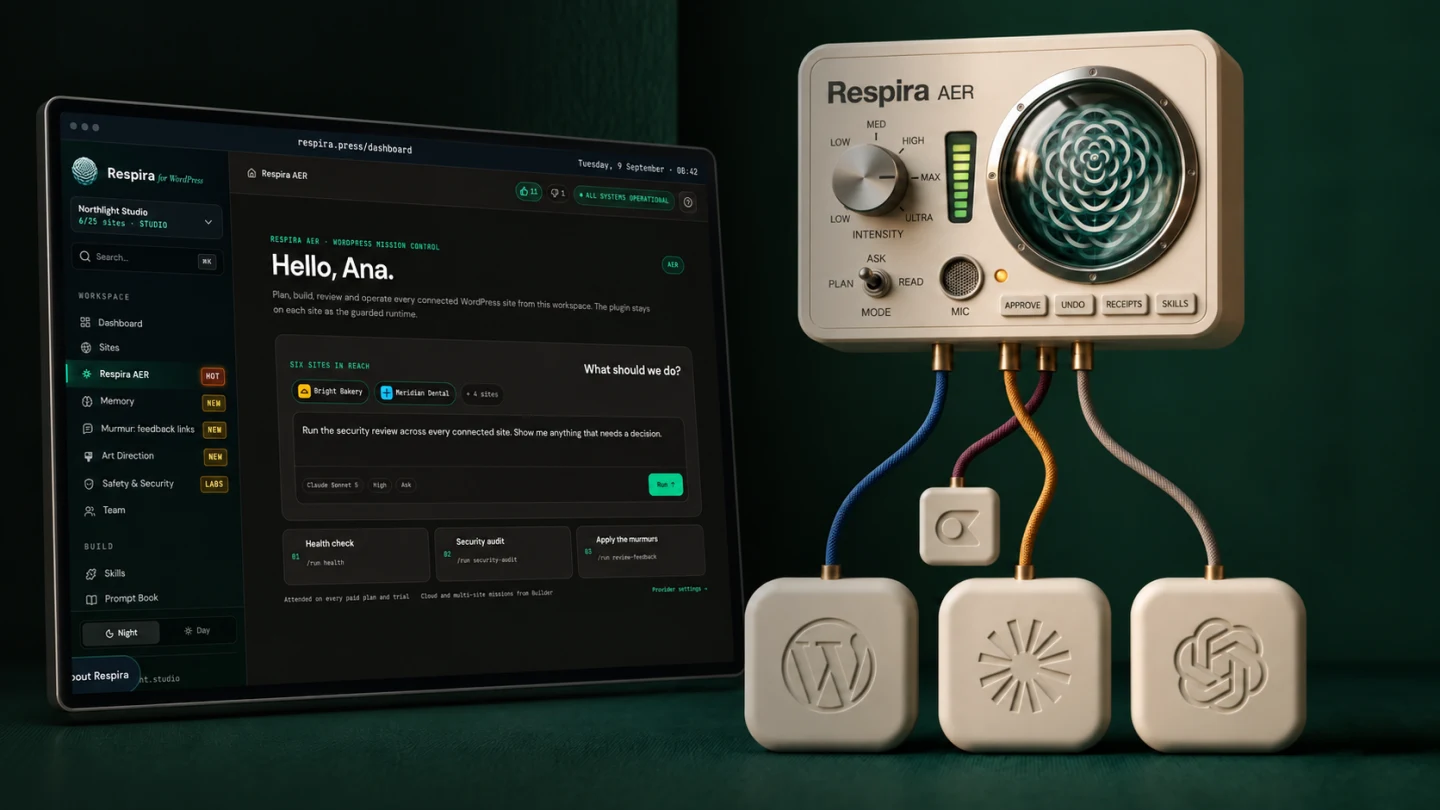
Respira AER is the agent workspace in the Respira dashboard. Respira for WordPress 9.0 is the runtime installed on each site: it gives AER secure access to the site's builders, memory, approvals, snapshots and receipts without putting another chat inside wp-admin. Across 8.x the plugin learned five things one release at a time. It remembers a site and enforces its rules. It knows the site's art direction and checks work against it. It lets clients talk back through Murmur. It lands a designed page as native builder output. And it proves what change runs did. Version 9.0 brings those parts together and adds an Open in Respira AER button plus a Ready for Respira AER checklist. Murmur links and client notes, spoken ones included, show up where you work. Site memory and Art Direction are on screen next to the pages they govern. The security audit gives the same answer whether you or your agent run it from an app connected over MCP, from Respira AER or from the site's own endpoint: the known vulnerabilities that match its plugins, themes and WordPress version, checked against Wordfence Intelligence, each with the version that fixes it, and never a clean report when that database cannot be reached. Change runs leave receipts, and reversible content work keeps its snapshot or undo.

1 chat connected to all your WordPress sites
4 model providers, on your own key
0 tokens marked up by Respira
  • Security A dry run no longer skips approval on a tool that cannot dry-run (and 8 more)
  • Removes Sentry (and 5 more)
Read the full story
Show the 53 entries
  • The AER release. Your site remembers, keeps its art direction, hears your clients and checks its security when you ask, and Respira AER is the first place that uses all of it at once. Nothing breaks: keys, connections, settings and snapshots carry over, and the plugin still needs only WordPress 5.8 and PHP 7.4. 9.0 also carries the 8.9.5 and 8.9.6 fixes, among them a bug where editing an Elementor page could change its accented letters (é saved as u00e9) and its line breaks: updating fixes it, and a page that was changed can be restored from its snapshot in Activity.

    Across the 8.x line, over 130 releases in seven weeks, the plugin stopped being a bridge with builder smarts and became the site's half of an agent workspace. It remembers the site and enforces its rules at the moment of the write (site memory, 8.3 and 8.6). It knows its art direction and checks pages against it (Art Direction, 8.5 and 8.6). It lets clients talk back, typed or spoken, through Murmur links (8.9). It lands a designed page as native builder modules: a page that scored 17 out of 100 as a conversion scores 100 on Divi 5 in fidelity mode (8.8.34). And it proves what every write did, with write receipts, a sealed audit log, a guard against collateral damage and fenced untrusted text (8.3 to 8.8). Along the way it gained 32 MCP tools in five families (Murmur, Art Direction, site memory, Divi presets and library, security), GreenShift as the 17th builder, access profiles, governance on every REST write, and security scans matched against known vulnerabilities for plugins, themes and WordPress itself.

    Respira AER, which opens with this release, uses all five together, across every site you connect, from a browser on a laptop or a phone. 9.0 brings it into wp-admin: open a site or a page in Respira AER from where you work, see whether Respira AER can work on the site and why, and read your clients' Murmur notes next to the rest of the site's activity. The security audit runs when you or your agent ask for it, from any app you connect, and every app now gets the same answer, known vulnerabilities included, with tools to fix what it finds. Nothing scans on its own. And the plugin got lighter: no Sentry, no Google Fonts, no hidden old admin, and nothing on your visitors' page views. Respira AER 0.2 arrives alongside, with the same readiness checklist for each site and passes for a security review, a client report and a review loop.

  • Open this site in Respira AER from wp-admin. When your plan includes Respira AER, Home has a Respira AER card that opens this site in it, the Respira AER row in Connected apps opens it too, and the admin bar offers "Ask Respira AER about this page" on any single page or post and in the editor, with the page already named in the prompt. Provider keys stay on respira.press. None of it shows on a white-labelled site.

  • Ready for Respira AER. A checklist on Home says in plain words whether Respira AER can work on this site: the licence, whether respira.press has reached the site recently, whether the access profile or the site's policy allows writes, whether your server passes the Authorization header through, and what your plan includes. Respira AER reads the same checklist from the site, so both sides give the same reasons.

  • Client feedback in wp-admin. Activity has a Feedback tab: live Murmur review links with copy and revoke, the notes your clients left grouped by page with the element each one points at, reply and resolve, a new review link for any page, and "Open in Respira AER" on every open note. Home tells you when client notes are waiting. Below the Builder plan, existing notes stay readable and the screen says what the plan includes.

  • Your agent can write the client report. generate_activity_report reads the site's activity log for any period and returns what changed, concrete examples and time saved, on the npm server and on the plugin's own MCP endpoint. The seven Respira skills that call it now work.

  • Two new tools fix what the security audit finds. update_theme updates a theme the audit flagged. revoke_application_password removes an application password you do not recognise, using the id the audit reports. Both ask for your approval first, and the password the request itself signed in with is never revoked.

  • A new major version says what it brings before you update. An update that crosses a major version now carries a one-line notice on Dashboard, Updates and under the plugin's row on the Plugins screen: what the release brings, that nothing breaks, and the minimum WordPress and PHP versions. A notice sent by the update server takes its place when there is one.

  • What's new describes 9.0. The About screen tells the AER release and the 8.x line behind it, reads the version from the plugin itself, and no longer shows counts and versions that went stale.

  • The welcome screen shows today's three steps: link the site to respira.press, connect Respira to your AI coding tool or open Respira AER, then ask for the three most recent posts.

  • Memory and Art Direction open the right dashboard page. "Edit in dashboard" goes to this site's Memory or Art Direction page on respira.press instead of the list of sites, and both screens can hand the work to Respira AER.

  • Old Respira admin links open the current screens in one step. Logs, Thank you, Approvals and the other addresses from before 7.1 open the matching screen of the current admin. Logs and Thank you used to open the old design.

  • Add-ons lists what you can buy today, the WooCommerce add-on and White label, instead of two add-ons that were never released.

  • Plans bought before the current pricing show as Starter (legacy) or Agency (legacy) in Settings.

  • Reports, Divi migration explains the readiness scan your agent can run, instead of saying the scanner is not available.

  • The Respira menu: Prompts is back in the WordPress sidebar, and the Founders page is no longer in it.

  • Visitors' page views no longer touch Respira's tables. The list of abilities Respira exposes is rebuilt only when something it depends on changes (an update, a playbook, an Inhale choice, the WooCommerce add-on), instead of on every request.

  • Usage reporting never slows down a change. Usage events are sent after the response, without waiting for an answer, and go straight to www.respira.press. The per-call usage counts now follow the opt-out switch in Settings (respira_usage_opt_out), as the other reports already did.

  • A lapsed licence is checked at most every 15 minutes, instead of on every request that asked.

  • get_core_web_vitals measures instead of estimating. It runs Google PageSpeed Insights and returns LCP, CLS and INP from real visitors when Google has the data, and it accepts a URL and a mobile or desktop strategy.

  • On the plugin's own MCP endpoint, update_option accepts any JSON type, plus the allow_type_change and allow_object_overwrite flags, the same as the npm server.

  • The Respira admin loads no fonts from Google. Its typefaces ship inside the plugin, so wp-admin sends nothing to a font service and looks the same offline or behind a strict security policy.

  • Tested up to WordPress 7.1, written in one place. The updater kept its own copies of "requires at least", "tested up to" and "requires PHP", and they drifted from the plugin header, so the update screen kept saying 7.0. It now reads the header, and an update server that describes the new version wins. Every respira.press address the updater calls uses www, so no request loses a redirect on the way.

  • The release zip carries only what runs. One exclude list builds both the release zip and the free build. The JSX and TypeScript sources, build scripts, developer tools and .env.example no longer ship in the release zip; the free build keeps the sources, because WordPress.org asks for the readable source of every minified file. The licence files of bundled packages now ship, and the build fails if the list ever drops a file the plugin reads at runtime.

  • The readme tells the truth about what leaves your site. A first-person privacy section, and an External services section that lists every call the plugin makes: what is sent, when, why and how to stop it. The description leads with the three ways in (your AI app, Respira AER and WebMCP), the FAQ covers today's flows, and the changelog keeps the last ten releases with a link to the rest.

  • Translations have one home. The bundled WebMCP screens and messages use the Respira text domain instead of the upstream plugin's, and the header no longer points at a languages folder that never shipped. A translation placed in wp-content/languages/plugins still loads.

  • Murmur stays out of page-builder editors. A stale or revoked review session can no longer mount the Murmur bar inside Divi's Visual Builder shell or canvas; the same guard isolates the frontend editing URLs used by Elementor, Bricks, Oxygen and Beaver Builder.

  • Plugin folders with spaces can be managed. Activate, deactivate, update and delete now accept the exact folder name WordPress reports instead of rejecting the route or looking for a different, sanitized folder.

  • A host-level LiteSpeed cache is no longer invisible. When the server identifies as LiteSpeed but its WordPress purge API is unavailable, cache reports say that stale HTML may remain at the host and point to the hosting control panel. Respira does not claim to have purged a layer it cannot reach.

  • WordPress 5.8, the minimum the plugin declares, works again. Four newer PHP string functions were replaced.

  • Deactivating Respira stops all of its scheduled tasks, including the Murmur relay and background jobs.

  • The "Setup guide" links in the one-click install grid open the right page on respira.press. They used to open a missing page on your own site.

  • The Divi 5 migration readiness report links to the right page.

  • The command palette counts 17 page builders, the same as the Builders screen.

  • Divi 5 duplicates can be edited independently. A copied element and every child now get fresh internal IDs, while links and other semantic references stay unchanged.

  • The Divi 5 pricing shortcut creates Divi's real pricing structure. It writes a Pricing Tables container with a Pricing Table child and keeps the plan's content on that child.

  • Divi 4 keeps third-party modules that Divi registered. A targeted edit beside a WPForms selector no longer refuses the whole write or drops the form module on round trip.

  • The companion MCP server 8.3.25 accepts the page ID names agents already use. Duplicate Page takes original_id, page_id or post_id and rejects a missing ID before any request.

  • In Settings, Browser AI, switching off "Publish all tools" lets you pick categories, instead of switching itself back on. The last category stays on, because none would mean all.

  • Admin messages and several screens read more plainly, Home, Activity, Setup and the admin bar among them, and the notices shown when both the free and the full plugin are installed. The network admin page is now called "Network sites and seats".

  • Sentry. Respira no longer loads Sentry's script in wp-admin and no longer sends the administrator's email and name to it. The plugin is about 1.7 MB smaller.

  • The previous admin design. It loaded hidden behind the current one on every Respira screen, and could flash on a slow connection.

  • The weekly accessibility task, which recorded a scan that never ran.

  • The "Enable" switch on the optional Settings, WebMCP page, which had no effect. Its public discovery and per-tool settings stay.

  • The Respira AER key box added in 8.7.0, which no screen could reach. Provider keys for Respira AER stay on respira.press.

  • The duplicate translation loader left over from when Inhale was a standalone plugin, and the Domain Path header that pointed at a folder the plugin never had.

  • A dry run no longer skips approval on a tool that cannot dry-run. The REST route let dry_run: true past the approval gate for every tool, but only make_responsive, the design token tools and apply_design_direction preview on that flag; the rest ignored it and wrote, so update_theme or revoke_application_password could run without a token. The skip now applies only to the tools that preview. The MCP transport never had the skip.

  • The security audit runs when you ask, and every app gets the same answer. You or your agent run it from any app you connect: Claude, ChatGPT, Cursor and the others, Respira AER, or wp-admin's own endpoint. Nothing scans on its own. Every app gets the same answer from the same tool, known vulnerabilities included: which installed plugin, theme or WordPress version matches the known vulnerability database (Wordfence Intelligence, matched on respira.press), how serious it is, and which version fixes it. When the database cannot be reached, the audit says so and never reports the site as clean.

  • Core security updates follow WordPress.org. When WordPress ships a security release for your branch, Respira can apply it the same day, without waiting for a Respira update first. Moving a site to a different WordPress branch is still refused.

  • Every plugin and theme update checks the site afterwards. The result now includes a health check (the REST API, the front page, and any fatal-error page), and tells the agent to stop a batch of updates when the site stops answering normally.

  • A deep scan only reads. The one check that writes a file (a harmless test file in uploads, to see whether the server would run PHP there) now has its own switch, probe_uploads_execution, and is off unless asked for. Security scans no longer set off file-change monitors.

  • Scan coverage is honest. Each bounded scan gets its full time budget, and the check for unexpected files in WordPress core says when it stopped early instead of reading as complete.

  • Only administrators can run the security audit.

  • Switching the Security category off in Settings, Browser AI switches off every security tool. The category now holds the audit, core security updates, theme updates and application password revocation. The audit and core updates used to sit under Site and context tools, so they stayed on.

  • "Delete everything" on uninstall deletes everything. It now also removes Murmur's reviewer data (names, emails and IP hashes), the WebMCP settings and the Inhale selection. The Inhale selection stays when the standalone Inhale plugin is active, because the two share it.

June 12, 2026
Clearing key visual

What the agent writes is what actually lands on the page

A deep pass through every supported builder, closing the gaps where a write reported success but the page stayed stale or blank. Styling now lands on Oxygen, Beaver Builder, Elementor v4 Atomic, Bricks, Divi 4 and Divi 5. Brizy and Visual Composer move from read to write, with their caveats stated. Recovery gets deeper: custom CSS and page settings are captured, and globals are versioned, so deleting a Bricks global class, a Divi preset, or an Elementor kit color leaves a recovery point. And when something cannot be persisted in a way the builder reads, Respira says exactly what did not land instead of reporting success. Every fix verified on a real site by loading the actual rendered page.

12 builders verified end-to-end
2 builders moved from read to write
6 verification stages per builder
Read the full story
Show the 18 entries
  • This release is about making sure that what the agent writes is what actually lands on the page, and that you can always get back to where you were.

    When you ask an AI agent to change a site, "success" should mean the change is live, not just that a database write returned without an error. Across a deep pass through every supported builder, I found places where Respira wrote data in a shape the builder didn't read, or skipped a step the builder needed to render, and reported success anyway. The page stayed stale, or blank, and the agent had no way to know. Clearing closes those gaps. Every fix in this release was verified on a real site with the real builder installed, by loading the actual rendered page, not by trusting the write.

  • Brizy moved from read to write. Respira can now write Brizy pages that Brizy's own editor opens and the front end renders. Writes are labeled with their caveats in the docs (front-end compile depends on Brizy's compiler service, so the site needs internet).

  • Visual Composer moved from read to write. Respira now writes in VC's canonical storage format, so the editor loads the page and the front end renders. Labeled with its caveats (VC recompiles on the next editor save).

  • Globals are now versioned. Deleting a Bricks global class, a Divi preset, or an Elementor kit color now leaves a recovery point. "The agent deleted my global class" used to be unrecoverable; now you can roll it back. Restores remain themselves undoable, so recovery can never make things worse.

  • Your own custom CSS and page settings are now captured in snapshots, so the edits Respira makes to things like custom CSS are recoverable, not just the main content.

  • Loud-drop behaviour across builders. When a value cannot be persisted in a way the builder reads, Respira names exactly what did not land and tells the agent not to retry blindly. This is the systemic version of the per-builder fixes below, and it cuts the retry loops that waste tokens.

  • An internal check now runs across the test fleet to confirm that every builder function Respira calls actually exists in that builder. It would have caught several of the silent failures below the day they were written, and it now runs continuously.

  • Oxygen: generated CSS was being written without the selectors it needed, so styles never reached the page. Element styling now renders, and dynamic content resolves correctly. Code blocks that contained quotes could corrupt a page; that is fixed.

  • Beaver Builder: style edits were serving stale CSS until you re-saved in the editor, because a cache flush was calling the wrong internal method and silently never ran. Style changes now appear immediately.

  • Elementor v4 (Atomic): styling writes now route correctly and the styles wire to the element, so colors, typography, breakpoint and state styles render. Atomic styling support is now claimable, with the supported element set documented.

  • Bricks: responsive style overrides were written in a key shape Bricks doesn't parse, so tablet and mobile rules silently did nothing. They now render at the right breakpoints.

  • Divi 4: responsive values needed a flag Respira wasn't writing, so tablet and phone styles quietly voided. They now apply.

  • Divi 5: several modules were receiving content in fields the renderer ignores, so the content was invisible. Team member, pricing, video, countdown, testimonial and others now render. Unsupported responsive keys now report loudly instead of silently dropping.

  • Snapshot fidelity tightened across builders, including the case where Oxygen migrated sites were capturing nothing. Restores now bring back the builder data they're meant to.

  • Synced patterns: updates aimed at a synced pattern now return a clear message naming the actual pattern to edit, instead of silently doing nothing.

  • WPBakery: raw HTML and unknown shortcode types are now encoded and reported correctly instead of rendering as garbage or literal brackets.

  • Gutenberg: buttons now write canonical markup so they render styled, and stale helper attributes are cleaned up.

  • Brizy and Visual Composer ship with the caveats above, labeled honestly in the builder list.

  • A few deep follow-ups remain documented and in progress (Breakdance section-background CSS in some layouts; Elementor structured-property aliases, which warn clearly today).

May 8, 2026
Bloom key visual

Every page-builder adapter promoted to deeper-intelligence parity

The biggest release since v5. Every builder adapter promoted in lockstep. Five cross-cutting Phase A invariants every adapter now inherits — render-validation gate, universal write-trace, Variables CRUD shape, source-driven catalog auto-scan, per-property typed validators — plus Phase B slices per builder that close the family-bug arcs surfaced across v6.10.x. 1076 standalone test assertions across 27 alpha cycles, zero failures.

7 builders blooming
5 cross-cutting invariants
1076 test assertions
Read the full story
Show the 17 entries
  • The cumulative GA release. Every alpha (1 through 27) rolls forward into this tag. Customer names anonymised throughout; technical details intact.

  • Every page-builder adapter promoted to deeper-intelligence parity, with five cross-cutting invariants that make the v6.10.x family-bug arcs not recur. Render-validation post-write, universal write-trace, Variables CRUD shape, source-driven catalog auto-scan, per-property typed validators.

    Phase A foundation (every adapter inherits)

  • A.1 Render-validation gate. Post-write check: HEAD-fetch the preview URL plus parser-walk the persisted blob using the parser the adapter declares. 9 parser slugs ship. Either failing surfaces partial_write: true with structured parser_error / preview_error.

  • A.2 Universal write-trace contract. Every adapter exposes build_write_trace($overrides) returning route, target, path_resolved, validator_warnings, render_validator_pass, partial_write, parser_error, preview_status, preview_response_ms, preview_error, render_validator_skipped, css_regen_strategy. Per-builder strategy declarations cover Bricks / Elementor / Beaver / Breakdance / Divi / Oxygen.

  • A.3 Variables CRUD endpoint shape. Universal /respira/v1/builder/{builder}/variables/{type} across color, typography, spacing, breakpoints. Five REST routes (GET list, POST create, GET read, PATCH update, DELETE).

  • A.4 Per-builder catalog auto-scan. Respira_Module_Catalog_Scanner replaces hand-curated registries with first-use filesystem scans; cached for 1 hour.

  • A.5 Per-property typed validators. 12 canonical type slugs (color / dimension / url / integer / number / boolean / string / enum / font_family / image_url / svg / class_list) with type-specific opts. Closes the data-vs-render gap shape from the v6.10.x family bugs.

  • A.6 PHP 8.1+ gate removed. WebMCP bridge boots on PHP 7.4 / 8.0 sites.

  • A.7 Abilities too-early-call guard. wp_get_abilities() called before init returns wp_abilities_not_yet_registered (425) instead of silent-empty.

  • Bricks: paper cuts (element-name validator with did-you-mean + _cssGlobalClasses on every schema), four missing global stores (bricks_global_variables / bricks_color_palette / bricks_breakpoints / bricks_pseudo_classes), Templates CPT first-class CRUD (PATCH / DELETE / structured conditions surface).

  • Divi: runtime-aware emit branching closes the silent-empty-render arc on Divi 4 sites (D5-shaped payloads downconvert to et_pb_* shortcodes when the site runs Divi 4); required-attrs hard error replaces 21 silent attribute drops; D5 module catalog source-driven scan from Packages/ModuleLibrary/.

  • Elementor (Atomic): $$type envelope-preserving writer for atomic v4 widgets (closes the round-trip corruption arc); 20-entry atomic catalog (9 widgets + 11 layout types); supports_children gate covers all 11 v4 layout types.

  • Oxygen: CSS regen force-load (closes the persistent empty-render arc by force-loading oxygen_vsb_cache_page_update outside admin_init); component primitive auto-catalog 7 to 42+ entries via filesystem scan; wrapper round-trip preservation (six per-component metadata fields survive extract, mutate, and re-inject); Oxygen 4 vs 6 dual-runtime catalog fork.

  • Beaver Builder: content_field_map 7 to 50 modules including PowerPack and Beaver Themer prefixes; shape_settings_for_beaver translator; Saved Rows + Theme Builder layouts surface.

  • Breakdance: widget shortcut map 20 to 70 entries covering every shipping EssentialElements\\* element; shape_settings_for_breakdance translator; Variables / CSS custom properties CRUD (closes the deferred unmapped-tokens arc from v6.11 Self-Heal).

  • WPBakery: builder-slug aliasing (vc / js_composer / visual-composer all route correctly); silent no-op canary on inject_content; catalog auto-scan 1 to 87 vc_* shortcodes via filesystem; pipe-delimited multi-key attribute encoder + decoder.

  • Customer names anonymised across the changelog, the readme, the What's New admin page, and every test file. The repo's release notes describe trial customers via generic descriptors ("an Oxygen Classic trial customer", "a Beaver Pro agency", "a Divi 5 calibration trial customer") so privacy posture matches the v6.11.0 release page convention.

  • 1076 standalone assertions across the 27 v700-bloom-* test files, 0 failures.

  • All pre-existing adapter tests still pass.

  • Every running localhost env (8881 Divi 5, 8882 Breakdance, 8883 Bricks, 8884 Elementor v4, 8886 Beaver, 8887 WPBakery, 8888 Divi 4) loads the plugin cleanly with no PHP fatals on the canonical REST surfaces (/respira/v1/diagnostic/report, /respira/v1/builder/{builder}/variables/{type}).

  • Internal alpha builds 7.0.0-alpha.1 through 7.0.0-alpha.27 (each documented separately below) sequenced the work; they are dev-only and not customer-shipped. Only this 7.0.0 tag publishes.

April 14, 2026

Oxygen Deep Intelligence

The deepest Oxygen Builder MCP integration available. 49 components, 140+ schema properties, fuzzy-matching settings validator, data repair pipeline, Oxygen 6 detection, and 10 layout patterns.

49 Oxygen components
140+ schema properties
10 layout patterns
Read the full story
Show the 2 entries
  • Oxygen Deep Intelligence: Full intelligence package for Oxygen Builder — 49 components cataloged with properties, types, defaults, and nesting rules. Component registry with dynamic detection and 24-hour caching. JSON Schema generation for any Oxygen component type. Validator with tree hierarchy checks, unique ID enforcement, color/URL/email validation, and detailed error messages. 6 ready-to-inject layout patterns (hero, features, CTA, testimonial, pricing, image+text).

  • Oxygen Settings Validator: Validates component properties and data types before injection — colors, URLs, emails, numeric values, booleans, and arrays all checked with detailed error messages.

March 23, 2026
Elemental key visual

Element-level editing across 11 builders

65 new tools. Element-level editing across every supported builder, build_page declarative page creation, HTML-to-builder conversion, stock-image search, tool governance, and dynamic schemas for 12 builders.

65 new tools
151 total tools
11 builders
Read the full story
Show the 48 entries
  • Element-level operations: find_element, update_element, move_element, duplicate_element, remove_element, batch_update (atomic), reorder_elements — works across all 11 builders via tree utility or native overrides.

  • build_page: Create complete pages from a declarative structure in a single API call. Returns preview URL.

  • Stock images via Openverse: search_stock_images and sideload_image with CC attribution, domain allowlist, SSRF protection, and deduplication.

  • Tool governance: Per-tool enable/disable with fail-open safety. Single chokepoint for REST + Abilities API. Audit logging.

  • Elementor dynamic schemas: Reads control registry at runtime, maps to JSON Schema types. Settings validator with "did you mean?" suggestions.

  • Divi 5 intelligence: 40+ module definitions, 7 page patterns, flex fraction system, design tokens, 13-point payload validation with 16 actionable error messages.

  • Builder tree utility: Generic tree traversal for find/insert/remove/clone/reorder with MAX_DEPTH=50 guard. Builder-agnostic via configurable children key.

  • Version migration engine: Respira_Upgrader runs sequential migrations on plugins_loaded. Schedules snapshot cleanup, sets governance defaults.

  • Builder interface safety CI test: Scans for new abstract methods and blocks PRs — prevents the v5.0.5 incident from recurring.

  • Version negotiation: GET /respira/v1/server/compatibility endpoint + X-Respira-Plugin-Version header on all REST responses.

  • HTML-to-builder conversion: convert_html_to_builder pipeline with CSS extraction, section mapping, style translation, and fidelity scoring. XSS sanitization first, never returns empty pages. Supports Elementor, Divi 5, Gutenberg, and all other builders via fallback.

  • Bulk page operations: bulk_pages_operation for applying changes across up to 100 pages. Built-in ops: strip_inline_styles, find_and_replace, custom. Rate-limited (3/hr), mandatory snapshots, concurrent lock.

  • Widget shortcuts: 27 convenience tools (add_heading, add_button, add_image, etc.) via data-driven registry with a single dispatch endpoint.

  • Dual tool registration: All tools available as both respira_* (preferred) and wordpress_* (deprecated). MCP server instructions teach AI to use respira_* names.

  • What's New admin page: Feature overview with builder support levels table. One-time redirect + dismissible notice.

  • UTF-8 passthrough for REST responses: Respira REST endpoints now output JSON_UNESCAPED_UNICODE so multibyte characters (Chinese, Japanese, Arabic, Cyrillic, etc.) are returned as readable text instead of \uXXXX escape sequences. Only applies to the Respira namespace.

  • Frontend cache purge on live edits: Automatic invalidation of WP Super Cache, W3 Total Cache, WP Fastest Cache, LiteSpeed, Autoptimize, SG Optimizer, WP-Optimize, Kinsta, and Cloudflare after direct (live) edits and duplicate approvals. Also fires respira_after_cache_purge action for third-party plugins.

  • Tool governance admin page: New "Governance" tab in wp-admin with per-category and per-tool enable/disable toggles, powered by the existing governance API.

  • Builder support level badges: Intelligence page now shows Full Intelligence / Smart Defaults / Basic Support badges next to each detected builder.

  • LemonSqueezy key detection: License activation form now detects UUID-format keys from LemonSqueezy order emails and shows a specific error directing users to respira.press/dashboard for their Respira key.

  • RankMath analysis: analyze_rankmath tool for sites running RankMath SEO.

  • API key access profiles: Generate keys with scoped permissions — Full Access, Read Only, Content Editor, or Builder. Each key only gets the tools it needs. Works alongside governance for layered security.

  • Admin UI/UX polish: Transparent logo, alternating row colors in settings tables, improved header alignment, builder support badges, and full changelog on What's New page.

  • Beaver Builder HTML conversion: Full HTML-to-Beaver conversion pipeline with type mapping (heading, rich-text, photo, button, video, separator, html), multi-column layout support via column-group/column structures, and content merging to BB-native settings keys.

  • Builder cache invalidation on approval merge: invalidate_builder_caches() fires after duplicate approvals for Bricks (CSS regeneration), Elementor (file cache clear), Beaver Builder (asset cache delete), and Divi (page resource auto-clear).

  • Angie/Elementor integration description: Settings page clarifies that Angie is the AI assistant built into Elementor, and explains how Respira registers as an MCP server inside it.

  • Built-in AI workflow guide: MCP server instructions now teach AI models how to use Respira — per-builder content formats (Elementor, Divi 5, Gutenberg, Beaver Builder, Bricks, and all others), common task recipes (update footer text, change images, add sections), and a clear rule to never access the database directly.

  • Oxygen ct_template detection: is_builder_used() only checked ct_builder_shortcodes meta but Oxygen templates can store content in ct_builder_json only. Now checks both meta keys, matching the logic already used in extract_content().

  • Changes page empty on SQLite/WordPress Playground: The Undo page SQL query used MySQL-specific syntax (CAST(... AS UNSIGNED) and parenthesized UNION ALL subqueries) that returned empty results on SQLite-backed installs (wp-now, WordPress Playground). Changed to CAST(... AS INTEGER) and unparenthesized unions — compatible with both MySQL and SQLite.

  • Trial-to-paid license orphan sites: When a trial user upgraded to a paid license without license_id in checkout custom_data, the webhook created a new license instead of converting the existing trial, leaving orphaned site records. The order_created handler now searches for recent trial licenses belonging to the same user and converts them (porting the Strategy 4 pattern from subscription_updated). Additionally, the license activation endpoint now cleans up orphaned trial site records for the same normalized URL.

  • Duplicate "license is a duplicate" admin banners: The license form handler and the per-page-load validation both queued the same error notice, showing two identical banners. Fixed by using a unique slug with add_settings_error() for WordPress deduplication and skipping the notice on POST requests when the form handler already added one.

  • Direct edit mode not applied: update_page and inject_builder_content endpoints now check the respira_auto_duplicate setting — when direct editing is enabled and auto-duplicate is off, writes go directly to the original post instead of queuing a duplicate.

  • Trial reminder email sent to paid users: Cron job and webhook now check for existing active paid licenses before sending trial expiration emails. Orphaned trial licenses are automatically converted to status: converted when a paid license exists.

  • Gemini/Antigravity MCP schema compliance: Added missing items property to 3 array schemas in apply_builder_patch.operations, update_custom_post.categories, and update_custom_post.tags — Gemini strict validator requires items on every type: 'array'.

  • Dead support links: Replaced 6 broken /docs/support/troubleshooting links across FAQ, 404 page, footer, and sidebar with working mailto:word@respira.press contact.

  • X handle references: Updated @Respira_cafe to @respira_press in trial extension sharing messages and modal instructions.

  • Beaver Builder injection 500 error: inject_builder_content with builder: "beaver" returned "Builder not supported" because the name resolver only matched exact names — "beaver" didn't match "Beaver Builder". Now handles single-word identifiers, hyphenated slugs, and compact forms for all multi-word builder names (Beaver Builder, Visual Composer, Thrive Architect).

  • Confirmation preflight before builder validation: inject_builder_content showed a confirmation prompt ("about to edit the original live Page…") before checking whether the builder was valid, leading to a misleading UX where users confirmed an operation that then failed with a 500. Builder validation now runs before the confirmation preflight.

  • Gutenberg block validation rejects valid payloads: The validator only accepted type field but users also send blockName (native WordPress format). Now accepts both. Also unwraps {blocks: [...]} wrapper objects that AI agents commonly send instead of flat arrays.

  • inject_builder_content content parameter undocumented: Added per-builder format examples and field requirements to the MCP tool schema description so AI agents can self-correct without trial and error.

  • Thank you to the early adopters whose reports and patience shaped this release:

  • Glen & Dave — for the detailed Beaver Builder bug report with reproduction steps that led to fixing the builder name resolver, the confirmation-before-validation ordering, and the Gutenberg block format handling.

  • Sam — for the Bricks builder reports that drove CSS regeneration on inject, approval merge cache invalidation, and the comprehensive Bricks test suite.

  • Jeroen — for catching the trial-to-paid license orphan bug and the duplicate admin banner issue.

  • William — for reporting the dead support links, SQLite/Playground compatibility issues, and other site-level bugs.

  • Yoliveras — for reporting the Gemini/Antigravity MCP schema compliance issue that was blocking strict validators.

  • Rixxter — for challenging us to do better with Elementor intelligence. His report about dropped sections and lost styles during HTML-to-builder conversion led directly to the CSS extraction pipeline, section mapping, style translation, and fidelity scoring — the entire HTML-to-builder conversion system that shipped in Elemental.

  • Sergei — for the idea of shipping built-in AI workflow instructions in the MCP server so models know how to use page builder tools correctly instead of falling back to SQL queries.

  • Walter — for reporting that Chinese characters were returned as \uXXXX escapes instead of readable text, which led to the UTF-8 passthrough fix across all API responses.

Showing the most recent 140 releases. Older entries are in the release feed. Every release follows semver.org.